German marketplace fulfillment
Selling print-on-demand products on Otto.de is not the same as launching a simple Shopify store. German marketplace selling requires cleaner product data, stricter delivery promises, structured returns, reliable order handling and a fulfillment workflow that can support marketplace expectations after the sale.
Quick answer: what POD sellers need before selling on Otto.de
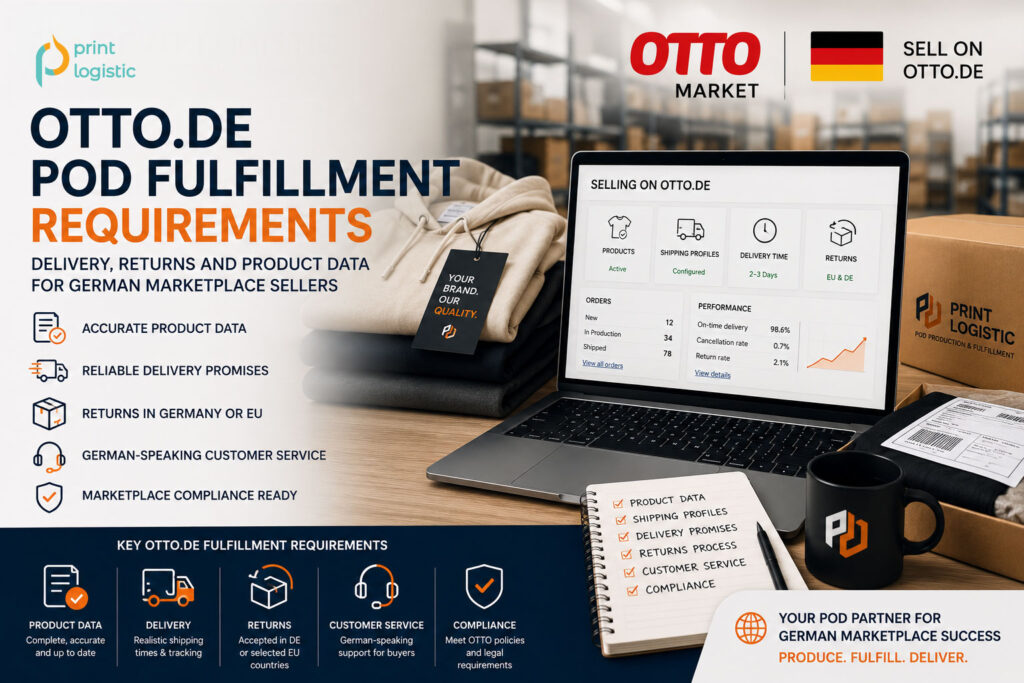
To sell POD products on Otto.de professionally, a seller needs more than attractive designs. The operation must support structured product data, SKU-level availability, realistic shipping profiles, reliable delivery times, return handling in Germany or selected EU countries, German-speaking customer service and clear order, shipment and return workflows. For POD brands, the biggest challenge is connecting made-to-order production with marketplace-level data accuracy and customer expectations.
Key takeaways
- Otto.de is a marketplace with operational rules, not just another traffic channel. Sellers need to prepare product data, delivery, returns and customer support before scaling.
- POD sellers must be especially careful with delivery promises. Made-to-order production has to be translated into accurate shipping profiles and realistic availability.
- Returns are a core requirement. OTTO Market states that returns must be accepted in Germany or selected EU countries, including Poland.
- The OTTO Market API is built around operational interfaces. Products, ShippingProfiles, Availability, Orders, Shipments, Returns, Receipts and ReturnShipments all matter.
- Basic POD apps may become limiting. Marketplace selling requires clean SKU data, tracking, return logic and consistent order status.
Why Otto.de Is Different from a Simple Online Store
When you sell through your own store, you control the customer journey. You decide how products are presented, how delivery is explained, how returns are handled and how much operational complexity you want to expose to the customer.
Otto.de is different. As a marketplace, it has its own expectations for seller onboarding, product data, shipping, returns, customer service and technical integration. That means a POD seller has to think beyond the product image and the design. The question is no longer only: “Can we print this?”
The better question is:
Can we list it accurately, produce it reliably, ship it on time, handle the return and keep the marketplace data consistent?
That is why Otto.de can be attractive for German market growth, but only when the backend is prepared. For a broader overview of German operations, start with our guide to POD fulfillment in Germany.
Who Can Sell on OTTO Market?
OTTO Market does not position itself as an open marketplace where every seller can immediately upload products. OTTO states that it checks basic requirements and capabilities before enabling a connection to Otto.de. Its seller-facing pages describe requirements around company location, legal and operational criteria, shipping from Germany or the EU, return handling and German-speaking customer service.
Recommended external sources:
For POD sellers, the practical meaning is simple: do not treat Otto.de as a place to test a random product catalogue. Prepare the operation first. Product data, delivery logic, returns and support need to be ready before the marketplace becomes a serious channel.
Product Data: The First Operational Barrier
For many POD sellers, product data starts informally. A product may be a hoodie, a color, a size and a print file. That might be enough for an early store test, but it is not enough for marketplace operations.
On OTTO Market, product data is part of the sales infrastructure. The OTTO Market API documentation describes product-related interfaces as part of the process for publishing products, managing visibility and checking marketplace status for errors. It also points to ShippingProfiles and Availability as interfaces that help get products online.
Recommended external source:
For a POD seller, product data should be clean before the first upload. That includes:
- stable SKU structure,
- clear product names,
- correct category mapping,
- brand information,
- size and color variants,
- material and care information,
- product images that match the actual item,
- delivery information linked to real production timing,
- availability logic that reflects what can actually be produced.
POD sellers often underestimate this part because product creation feels easy inside a standard POD tool. Marketplace selling is less forgiving. A weak product data structure can create listing errors, wrong expectations, customer complaints and operational delays.
Shipping Profiles and Delivery Promises
Delivery promises are one of the most sensitive parts of marketplace fulfillment. A customer does not care whether a product is made on demand, printed after purchase or prepared by a partner. The customer sees an expected delivery time and expects the seller to meet it.
The OTTO Market API documentation explains that shipping profiles define logistical details for different orders and can be used to manage delivery times. It also describes parameters such as processing time, transport time and order cut-off. For POD sellers, this is important because production time and shipping time must be translated into a realistic marketplace promise.
Recommended external source:
For POD, the key question is not “how fast can we ship on a good day?” The key question is:
What delivery promise can we keep consistently when orders arrive, products are printed, quality checked, packed and dispatched?
A strong fulfillment setup should define:
- production time by product type,
- cut-off logic for orders,
- realistic handling time,
- carrier handover time,
- delivery time by country,
- peak-season buffer,
- rules for products with different production methods.
For German customers, vague delivery promises are risky. If your brand wants to compete on Otto.de, your fulfillment partner must help turn POD production into predictable delivery logic.
Returns: Why German Marketplace Buyers Expect a Clear Process
Returns are not an optional detail on a serious German marketplace. OTTO Market’s seller checklist states that goods are shipped from a warehouse in Germany or the EU and that returns are accepted in a warehouse in Germany or in selected EU countries, including Denmark, France, Italy, the Netherlands, Austria, Poland, Spain and Czechia. It also states that returns to other EU countries are not possible.
This detail matters for Print Logistic because Poland is one of the selected EU countries listed by OTTO Market for return acceptance. For POD sellers working with a European production and fulfillment setup, that can be operationally important.
Recommended external sources:
For POD sellers, returns need extra attention because not every case is the same. A seller may need to distinguish between:
- a standard customer return,
- a cancellation before production,
- a quality complaint,
- a wrong-size issue,
- a misprint or damaged item,
- a personalized item with different return handling rules.
If your store also sells into Germany through its own website, withdrawal and return handling should be reviewed carefully. For more context, read our guide to BGB §356a for POD stores.
Returns Warehouse and Return Shipments: What the Workflow Must Track
OTTO Market’s API documentation includes a ReturnsWarehouse API for retrieving, creating, updating or deleting warehouse addresses where customers can return parcel shipment items. It also describes return warehouse types including national addresses in Germany and international addresses in selected countries such as Poland, Austria, the Netherlands, France, Spain, Denmark, Italy and Czechia.
Recommended external sources:
The operational lesson is clear: returns must be part of the system, not handled as a side conversation in email. A POD seller should be able to connect the return case to the original order, product, SKU, shipment, customer communication and refund or replacement decision.
| Workflow element | Why it matters on Otto.de | POD fulfillment implication |
|---|---|---|
| Order ID | Connects order, shipment, receipt and return | Every production and support event should remain traceable |
| SKU and variant | Identifies the exact item sold | Size, color and product type must be mapped accurately |
| Production status | Helps determine whether an order can still be changed | Essential for made-to-order products |
| Shipment tracking | Supports delivery visibility and customer communication | Tracking should connect back to the marketplace order |
| Return shipment | Shows that the customer has announced or sent a return | Return handling must be integrated into support and accounting logic |
| Receipt / financial documentation | Documents customer billing processes | Refunds and corrections should not be disconnected from fulfillment events |
If these elements are fragmented, marketplace selling becomes stressful. If they are connected, customer support, accounting and fulfillment can work from the same operational truth.
Orders, Shipments, Returns and Receipts: Why the API Structure Matters
The OTTO Market API documentation is a useful window into what marketplace readiness really means. It is not only a technical manual. It shows the operational building blocks a seller has to manage.
The API Guidelines group interfaces around two large use cases: preparing the sales process and managing orders and returns. Product, ShippingProfiles and Availability help prepare the offer. Orders, Shipments, Returns, Receipts and ReturnShipments support order and return management.
For POD sellers, this structure matters because made-to-order production must fit into an already structured marketplace process. You need to know:
- when an order is ready to process,
- which SKU and artwork belong to the order,
- whether the product is available and producible,
- which shipping profile applies,
- when the shipment is created,
- how tracking is passed back,
- how returns are announced and monitored,
- how receipts and financial documentation relate to the order.
That is why serious POD marketplace selling depends on data discipline. The product may be printed on demand, but the workflow cannot be improvised on demand.
Why Basic POD Apps Can Become Limiting on Marketplaces
A basic POD app can be good for testing a store, validating designs or starting with a small catalogue. But Otto.de selling usually requires a more mature operational setup.
Basic tools can become limiting when:
- product data is not structured enough for marketplace requirements,
- SKU logic differs between store, POD tool and marketplace,
- delivery promises cannot be mapped accurately,
- returns are handled manually without clear order linkage,
- tracking data is delayed or inconsistent,
- product availability does not reflect real production capacity,
- support teams cannot see production status quickly,
- refunds and returns are disconnected from operational events.
This is where the difference between a simple POD tool and a production-focused fulfillment partner becomes important. If you are only testing a niche, simplicity may be enough. If you want to sell through a German marketplace, operational depth matters.
Otto.de Readiness Checklist for POD Sellers
| Area | What to prepare | Why it matters |
|---|---|---|
| Seller requirements | Company eligibility, VAT, operational criteria, German-speaking support | OTTO checks seller capabilities before connection |
| Product data | SKUs, variants, descriptions, categories, images, attributes | Marketplace listings depend on structured and accurate data |
| Availability | SKU-level availability and production capacity | POD products must not promise availability that production cannot support |
| Shipping profiles | Processing time, transport time, cut-off logic, delivery promise | Delivery accuracy affects customer trust and marketplace performance |
| Returns warehouse | Return acceptance in Germany or selected EU countries | Returns are a core OTTO Market requirement |
| Order workflow | Order ID, position items, SKU, artwork, status, tracking | Production and marketplace order handling must stay connected |
| Customer support | German-language support and clear answer paths | German marketplace buyers expect clarity and responsiveness |
| Compliance | Packaging, returns, product rules and marketplace policies | German operations require more than product upload |
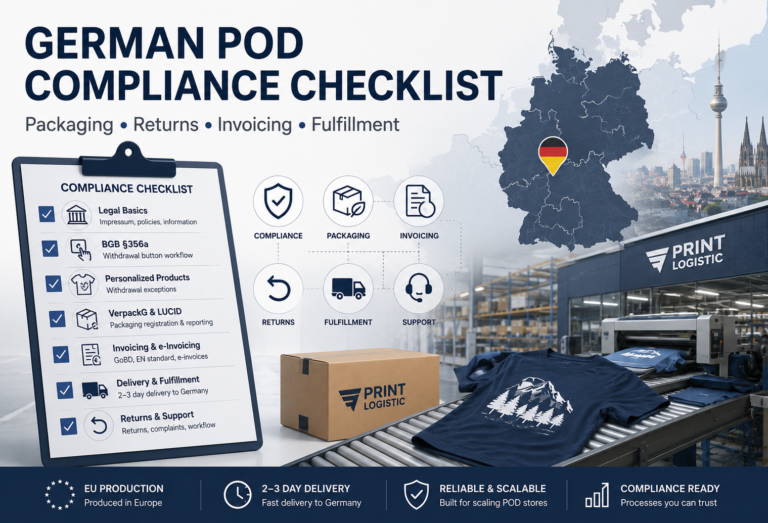
For a wider operational checklist, see our German POD compliance checklist.
Where Print Logistic Fits Into Otto.de POD Operations
Print Logistic is not a marketplace agency and does not replace the seller’s legal, tax or OTTO onboarding responsibilities. But for POD sellers preparing for Otto.de, a strong production and fulfillment partner can make the operational side much more realistic.
Print Logistic can support German marketplace-oriented POD operations with:
- EU-based print-on-demand production,
- 2–3 day delivery to Germany,
- structured order workflows,
- support for SKU-based production logic,
- production and shipment visibility,
- returns-aware operational thinking,
- experience with scaling e-commerce production beyond simple POD tests.
For sellers who are also preparing for social commerce demand, read our guide on TikTok Shop expansion and POD fulfillment readiness.
Preparing POD operations for German marketplace growth?
Talk to Print Logistic about EU-based production, delivery to Germany, order workflows and fulfillment readiness for scaling e-commerce and marketplace sellers.
Final Takeaway
Otto.de can be a serious opportunity for POD sellers targeting Germany, but it is not a shortcut. The marketplace environment rewards operational clarity. Product data must be clean. Shipping profiles must be realistic. Returns must be planned. Order status, tracking and return workflows must be connected.
For print-on-demand sellers, the challenge is translating flexible production into marketplace discipline. That means building a workflow where every order can move from product data to production, shipment, receipt and return handling without losing traceability.
The brands that prepare this backend before scaling will be in a much stronger position than sellers who treat Otto.de as just another place to upload designs.
Frequently Asked Questions
Can POD sellers sell on Otto.de?
POD sellers may be able to sell on Otto.de if they meet OTTO Market requirements and can support the necessary product data, shipping, returns, customer service and operational workflows. The seller must also make sure the product range is suitable for marketplace requirements.
What does a POD seller need before selling on Otto.de?
A POD seller needs structured product data, clean SKUs, realistic delivery information, return handling, German-speaking customer support, order tracking and a fulfillment workflow that can support marketplace expectations.
Why is product data important for Otto.de POD sellers?
Product data affects whether products can be listed, found, understood and purchased correctly. For POD sellers, product data must connect designs, SKUs, variants, sizes, colors, availability and delivery information.
Where must Otto.de sellers accept returns?
OTTO Market states that returns must be accepted in a warehouse in Germany or selected EU countries, including Denmark, France, Italy, the Netherlands, Austria, Poland, Spain and Czechia. Returns to other EU countries are not possible according to the seller checklist.
What are shipping profiles on OTTO Market?
Shipping profiles define logistical details such as processing time, transport time and delivery rules. For POD sellers, they help translate production and shipping reality into a marketplace delivery promise.
Why can basic POD apps be limiting for Otto.de?
Basic POD apps may not provide enough control over marketplace-grade product data, SKU logic, shipping profiles, returns, tracking and order status. Otto.de selling usually requires a more structured operational setup.
How can Print Logistic support German marketplace operations?
Print Logistic can support EU-based POD production, delivery to Germany, structured order workflows, production visibility and fulfillment operations for sellers preparing for German marketplace growth.