Scaling a print-on-demand (POD) business used to mean one thing: more products, more listings, and more manual work. Every new design required another mockup set, another title to write, another description to optimize, and another product to upload — marketplace by marketplace. And when your store finally started growing, fulfillment coordination often became the next operational bottleneck.
This is exactly where the integration between Print Logistic and MyDesigns makes a difference. Instead of treating product creation and production as separate environments, the integration connects both stages into one structured workflow that supports faster launches and more predictable scaling.
The result is simple but powerful: sellers can publish collections faster, manage larger catalogs more efficiently, and expand across marketplaces without increasing operational complexity.
Let’s take a closer look at how this works in practice — and why this integration is especially relevant for sellers preparing to scale their operations in 2026.
The hidden challenge behind scaling a POD catalog
When sellers think about scaling their print-on-demand business, they usually focus on production capacity or shipping speed. In practice, however, the first real bottleneck appears much earlier — at the listing preparation stage.
Before a product can be printed or shipped, it needs to exist as a complete marketplace-ready offer, including mockups, product variations, descriptions and structured metadata. Preparing this infrastructure manually becomes increasingly time-consuming as catalog size grows.
This is why many stores slow down not because they run out of ideas, but because preparing listings becomes difficult to scale. Instead of testing new collections or expanding into additional niches, sellers often spend hours repeating technical setup steps that do not directly contribute to growth.
Platforms like MyDesigns were created specifically to solve this stage of the workflow by enabling sellers to prepare products in bulk and manage larger catalogs more efficiently.
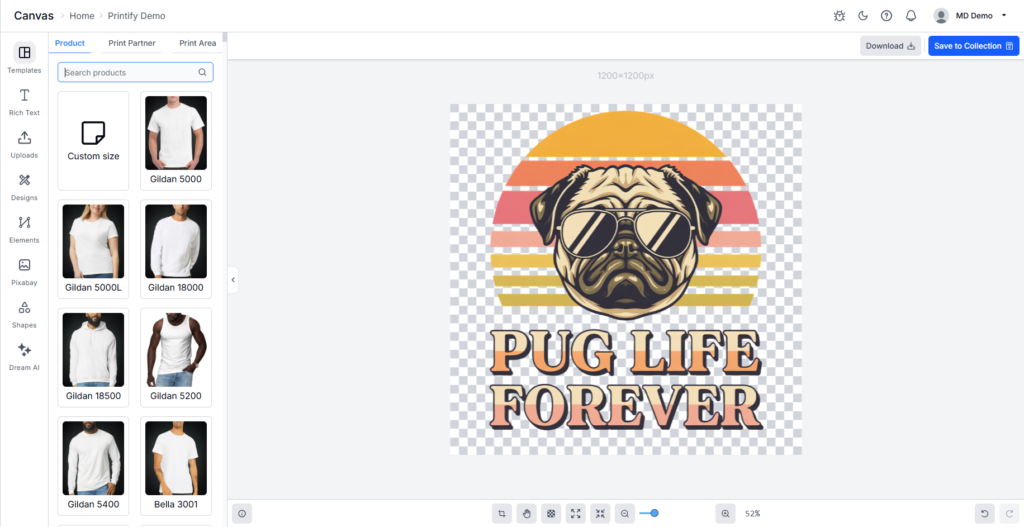
What MyDesigns does inside the POD workflow
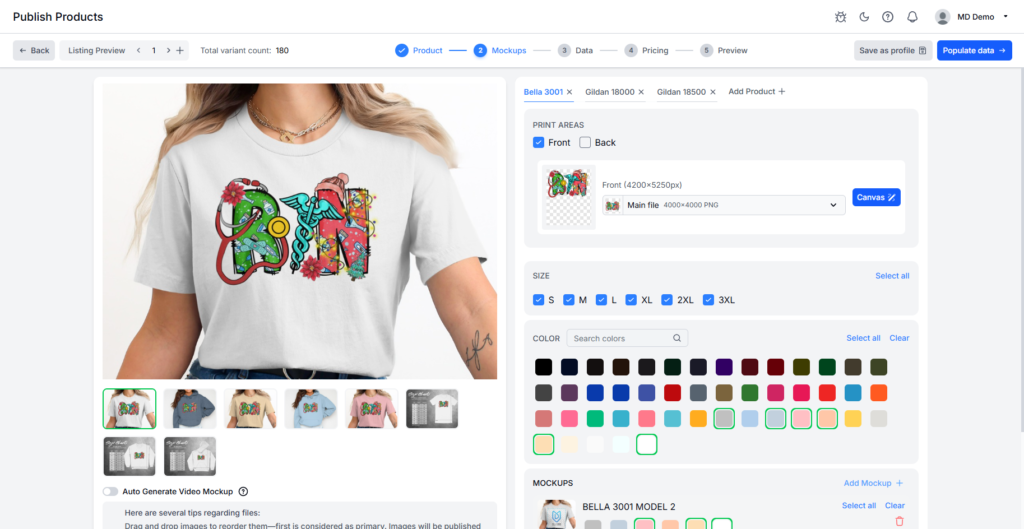
MyDesigns is an automation platform designed for print-on-demand sellers who publish products across multiple marketplaces such as Etsy, Shopify, TikTok Shop and WooCommerce. Instead of preparing listings individually, sellers can generate product variations, create mockups and optimize listing content in a centralized environment.
Visit the MyDesigns website to learn more about the platform and its capabilities.
This changes how catalogs are built. Rather than treating each listing as a separate task, sellers can manage entire product groups and launch collections more strategically. This approach becomes particularly valuable when working with seasonal releases, niche testing strategies or variation-heavy product structures.
When connected with Print Logistic as a fulfillment partner, MyDesigns becomes part of a broader workflow that links listing preparation directly with production infrastructure.
How the Print Logistic × MyDesigns workflow works in practice
One of the strongest advantages of the integration is that it simplifies the transition between publishing and fulfillment without forcing sellers to rebuild their existing setup.
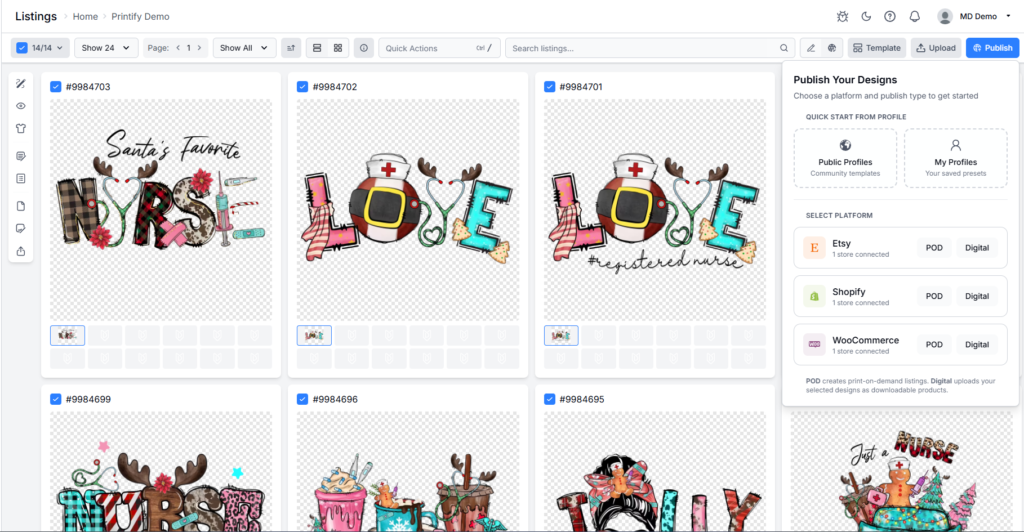
Designs can be uploaded into MyDesigns in bulk and organized into structured collections. Product variants can then be mapped to Print Logistic catalog items, while mockups and listing content are generated automatically across supported marketplaces. Once listings go live and orders begin to appear, production is handled directly inside Print Logistic’s factory-based infrastructure in either Europe or the United States.
Learn more about our US production →
Instead of switching between platforms or manually synchronizing order data, sellers can maintain a continuous workflow from design preparation to fulfillment.
This becomes especially valuable when launching larger collections or testing multiple product ideas at once, because catalog expansion no longer introduces additional coordination steps between tools.
Comparing traditional POD workflows with an integrated setup
As catalogs grow, the difference between manual listing workflows and connected publishing and fulfillment infrastructure becomes increasingly visible. The table below illustrates how the Print Logistic × MyDesigns integration changes everyday operations for sellers working at scale.
| Feature | Traditional POD Workflow | Print Logistic × MyDesigns |
|---|---|---|
| Listing creation | Prepared one product at a time | Bulk publishing across multiple products |
| Mockups | Created manually in external tools | Generated automatically inside workflow |
| Listing optimization | Manual titles, tags and descriptions | AI-supported listing preparation |
| Marketplace publishing | Platform-by-platform setup | Multi-channel publishing from one environment |
| Fulfillment routing | Export/import between systems | Direct API-based fulfillment connection |
| Production structure | Often based on distributed partner networks | Factory-based infrastructure in Europe and the US |
| International expansion | Cross-border shipping complexity | Local fulfillment on two continents |
| Scaling catalogs | Increases operational workload | Supports structured catalog expansion |
Built for sellers working across multiple channels
Today, many print-on-demand businesses operate across more than one platform. It is increasingly common to see sellers combining Etsy with Shopify stores, testing TikTok Shop, or managing several niche storefronts simultaneously.
In these situations, the ability to prepare listings in bulk and maintain consistency across channels becomes essential. MyDesigns supports this type of workflow by allowing sellers to manage variations, optimize listings and publish products across marketplaces from one environment.
When connected with Print Logistic as a fulfillment partner, this structure helps maintain operational continuity even as catalog size and marketplace coverage increase.
Why automation is becoming essential in modern POD workflows
Over the past few years, print-on-demand has evolved from a creator-driven niche model into a production strategy used by brands, agencies and multi-channel sellers. As a result, expectations around publishing speed and catalog flexibility have changed significantly.
Launching only a few products per month is no longer enough in many marketplaces. Sellers increasingly need the ability to test ideas quickly, respond to trends and publish variations at scale.
Automation platforms like MyDesigns support this shift by allowing sellers to generate listing structures faster and prepare marketplace-ready product sets more efficiently. When this process is connected directly with Print Logistic production infrastructure, publishing new products no longer creates additional operational friction.
Instead, catalog growth becomes easier to manage within one connected workflow.
Why fulfillment infrastructure still makes the biggest difference when scaling
Automation improves how products are prepared, but fulfillment determines whether scaling remains predictable.
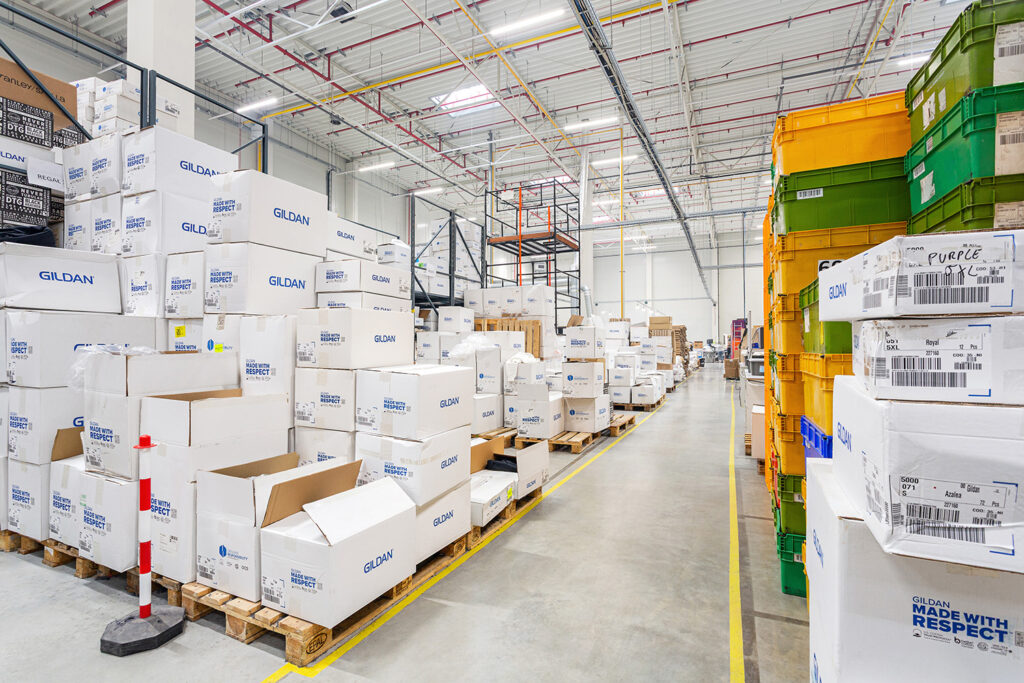
Unlike marketplace-style fulfillment aggregators that route orders through distributed partner networks, Print Logistic operates its own factory-based production infrastructure. This allows sellers to maintain consistent print quality, stable lead times and predictable order handling as their stores expand.
This reliability becomes especially important when launching larger collections, managing variation-heavy catalogs or preparing seasonal campaigns where production consistency directly affects customer experience.
Supporting global growth with production in both Europe and the United States
International scaling often introduces logistics complexity, especially when stores serve customers on both sides of the Atlantic.
Print Logistic supports this type of expansion through production infrastructure located in both Europe and the United States. This allows orders to be fulfilled closer to the end customer, reducing delivery distances and improving predictability of shipping timelines.
For brands expanding from Europe into the U.S. market — or from the U.S. into the EU — this setup creates a more flexible environment for testing new regions without rebuilding fulfillment workflows.
Combined with the automation capabilities of MyDesigns, this production structure enables sellers to publish globally while fulfilling locally.
A connected infrastructure for scaling print-on-demand businesses
As the print-on-demand industry continues to mature, scaling is no longer only about adding new products. It increasingly depends on building workflows that connect creation, publishing and fulfillment into one structured system.
The integration between Print Logistic and MyDesigns supports exactly this type of approach. By linking listing automation with factory-based production infrastructure across Europe and the United States, sellers can expand their catalogs more efficiently while maintaining operational clarity as their business grows.
For sellers preparing new collections, entering additional marketplaces or building variation-rich product portfolios, this integration provides a practical foundation for a more scalable print-on-demand workflow.
If you would like to explore how the Print Logistic × MyDesigns integration can support your current setup, contact our team to get started.