Quick answer
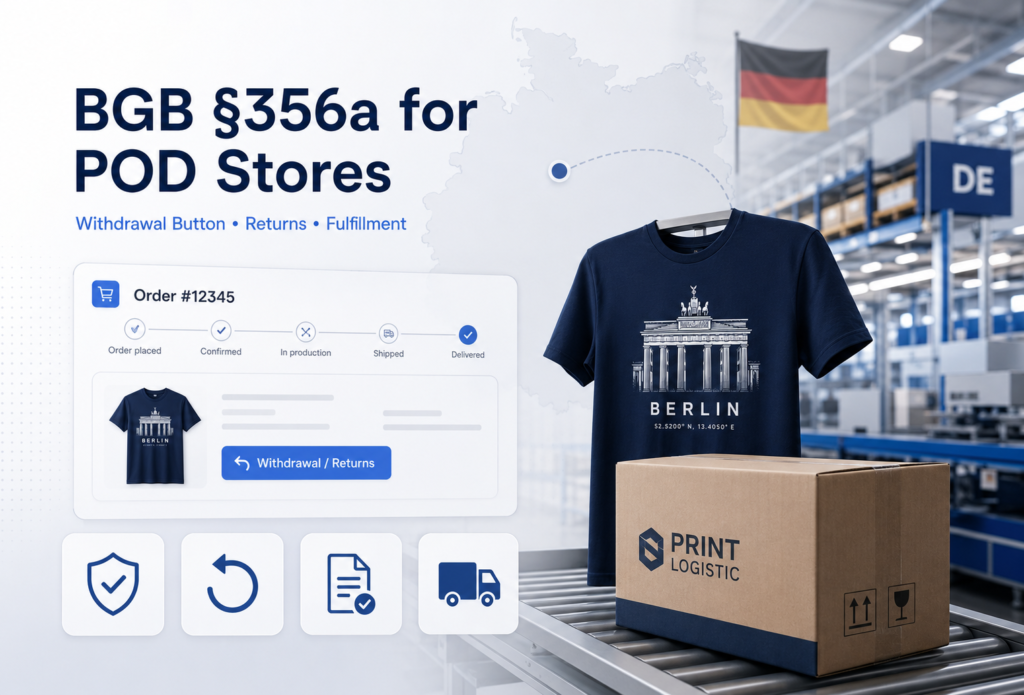
From 19 June 2026, German online stores that conclude certain B2C distance contracts through an online interface will need to provide an electronic withdrawal function, commonly called the Widerrufsbutton or withdrawal button. For print-on-demand sellers, this is not only a legal UX change. It can affect cancellation handling, production timing, return workflows, customer communication and the way order status data flows between the store, the platform and the fulfillment partner.
- Relevant market: German B2C e-commerce.
- Relevant business model: POD stores, Shopify stores, WooCommerce stores, marketplaces and custom storefronts selling to German consumers.
- Main operational issue: whether a withdrawal or cancellation request arrives before or after the POD order enters production.
- Best next step: connect legal implementation with fulfillment workflow design, not only with a button on the website.
Germany is one of Europe’s most attractive print-on-demand markets, but it is also one of the most compliance-sensitive. For growing POD sellers, the German market requires more than good products and fast ads. It requires reliable delivery promises, transparent returns, legally consistent customer communication and fulfillment processes that can support what the online store promises.
The new BGB §356a withdrawal button is a good example of why German POD operations need to be treated seriously. On the surface, the requirement looks like a website or checkout change. In reality, it can influence how a seller handles cancellations, withdrawals, order status, production timing and customer support.
This article explains what BGB §356a means for POD sellers, why the withdrawal button matters for fulfillment, and how scaling stores should prepare their operational workflows before June 2026.
If you are building your wider German fulfillment setup, start with our main guide: POD fulfillment in Germany.
Scaling POD in Germany?
Print Logistic supports German POD operations with EU-based production, 2–3 day delivery to Germany and fulfillment workflows designed for sellers who need reliability, automation and operational clarity.
Talk to the Print Logistic team
What Is BGB §356a?
BGB §356a is the new section of the German Civil Code introducing an electronic withdrawal function for online contracts. The rule implements changes coming from EU consumer law, especially Directive (EU) 2023/2673, which adds an electronic withdrawal function to the Consumer Rights Directive framework.
In simple terms, if a consumer can conclude a relevant B2C distance contract through an online interface, the consumer should also be able to withdraw from that contract through an easy-to-access electronic function. German legal commentary refers to this as the Widerrufsbutton, or withdrawal button.
According to Noerr, the implementing legislation has been published and the new Section 356a of the German Civil Code enters into force on 19 June 2026. German consumer organization Verbraucherzentrale also explains that from 19 June 2026 companies must provide a withdrawal button where contracts can be concluded through their website.
Recommended sources:
- Noerr: Implementing legislation for the withdrawal button
- Verbraucherzentrale: Widerrufsbutton ab Juni 2026
- EUR-Lex: Directive (EU) 2023/2673
Why the Withdrawal Button Matters for POD Sellers
For a standard e-commerce store selling stocked products, a withdrawal request often triggers a return workflow. For a print-on-demand store, the situation can be more complex because the product may be personalized, made to order, already in production or already shipped by a third-party fulfillment partner.
This creates a practical problem:
The legal withdrawal interface may sit on the storefront, but the operational impact happens inside the fulfillment workflow.
A POD seller should therefore not treat BGB §356a as a narrow website task. The seller needs to understand what happens after a customer clicks the withdrawal function. Does the order pause automatically? Does customer support receive a ticket? Is the fulfillment partner notified? Can production still be stopped? Is the item personalized? Is there a statutory right of withdrawal in that specific case? Is the customer sent confirmation on a durable medium?
These are operational questions, not only legal ones.
Does BGB §356a Apply to All Print-on-Demand Products?
Not necessarily. This is one of the most important points for POD sellers.
EU consumer law generally gives consumers a 14-day right of withdrawal for many distance contracts. However, the Consumer Rights Directive includes exceptions, including goods made to the consumer’s specifications or clearly personalized. This exception is highly relevant to print on demand, especially for products printed with a customer’s own text, name, image or custom design.
Recommended sources:
- EUR-Lex: Consumer Rights Directive 2011/83/EU
- Stripe: Right of withdrawal in online commerce in Germany
However, POD stores should be careful. Not every product sold through a POD model is automatically exempt. There may be a difference between:
- a generic print-on-demand product with a standard design selected from a catalogue,
- a personalized item created according to a customer’s specific input,
- a made-to-order product that is not necessarily personalized,
- a product that has entered production but may still fall within normal consumer withdrawal rules,
- a marketplace listing where platform rules may be stricter than the seller’s internal interpretation.
Because of this, POD sellers should not assume that “POD equals no withdrawal right.” Instead, they should consult legal counsel and map their product types into clear withdrawal categories.
Important: This article is not legal advice. German consumer law can be highly specific, especially for personalized goods, digital products, services, mixed carts and marketplace sales. Sellers should ask a qualified legal advisor to review their withdrawal policy, product categories and implementation before the June 2026 deadline.
The Core Fulfillment Problem: Has the Order Entered Production?
For POD operations, the most important operational question is simple:
When the customer submits a withdrawal or cancellation request, where is the order in the production workflow?
There are usually several possible stages:
| Order stage | Operational meaning | Why it matters for withdrawal handling |
|---|---|---|
| Order received | The store has accepted the order, but fulfillment has not started. | The order may still be easy to stop if the workflow supports fast cancellation routing. |
| Order validated | Artwork, product data and payment are checked. | The seller needs clear status visibility before deciding what can be changed. |
| In production | The item is being printed, cut, packed or otherwise produced. | The seller needs to know whether production can still be stopped and what cost implications apply. |
| Packed | The product is ready for dispatch. | Stopping the order may be difficult; customer communication must be precise. |
| Shipped | The parcel has left the fulfillment facility. | Return handling and customer instructions become the main issue. |
| Delivered | The customer has received the item. | The seller must apply the correct return or withdrawal policy for the specific product type. |
If a seller cannot identify the order stage quickly, support becomes reactive. The customer clicks the withdrawal button, but the business does not know whether the order can be cancelled, stopped, returned, refunded or excluded. This is the exact type of operational gap that can damage trust in the German market.
What a Proper Withdrawal Workflow Should Include
A German POD seller should build a withdrawal workflow that connects the storefront, customer service, legal policy and fulfillment partner. The goal is not only to place a compliant button on the website. The goal is to make sure the business can process the signal correctly.
A practical workflow should include:
- Withdrawal request capture — the customer submits the request through the electronic function.
- Automatic confirmation — the customer receives confirmation in a durable format, usually by email.
- Order identification — the system connects the request to order ID, customer data and product SKU.
- Product category check — the seller identifies whether the product may be subject to a withdrawal exception.
- Production status check — the fulfillment workflow confirms whether the order is pending, in production, packed or shipped.
- Decision routing — the request is routed to cancellation, return, refund review or customer support.
- Customer communication — the customer receives clear information about the next step.
- Documentation — the seller keeps a record of the request, response, status and outcome.
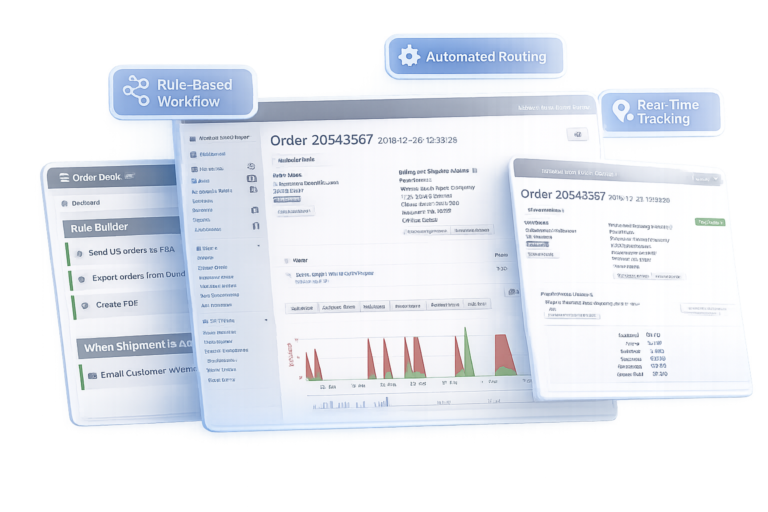
This is where a fulfillment partner can make a real difference. A seller that has fast order status visibility and clear production events can respond more accurately than a seller relying on fragmented tools and manual checks.
Shopify, WooCommerce and Marketplace Sellers: What to Check
Many POD sellers use Shopify, WooCommerce, marketplaces or custom e-commerce setups. The BGB §356a issue should be reviewed across all active sales channels targeting German consumers.
Here is a practical checklist:
- Can German consumers conclude contracts directly through your online interface?
- Do your products fall under standard withdrawal rights, exceptions or mixed categories?
- Will your platform, theme or app support a compliant withdrawal function before June 2026?
- Can the withdrawal request be connected to the correct order ID?
- Can your support team see whether the POD order has entered production?
- Can your fulfillment partner stop an order before production starts?
- Do you have different handling rules for personalized and non-personalized products?
- Can you document the withdrawal request and your response?
- Does the customer receive clear confirmation?
- Does the process match your legal policy, marketplace settings and actual fulfillment workflow?
The risk is not only that the button is missing. The larger operational risk is that the button exists, but the business behind it cannot process the request consistently.
Why Personalized POD Products Need Special Attention
Print-on-demand sellers often rely on personalization: names, dates, photos, slogans, custom graphics and niche designs. This can create a potential exception to the right of withdrawal, but it also creates a communication challenge.
If the seller believes a product is excluded from the right of withdrawal, this must be communicated clearly and legally correctly. Vague statements such as “all POD products are non-refundable” may be risky if the store also sells non-personalized products or standard catalogue items.
Better operational practice is to separate product types:
- Standard POD catalogue products — may require normal withdrawal handling depending on legal analysis.
- Clearly personalized products — may be treated differently, but the customer should be informed clearly.
- Mixed carts — may require separate handling rules for different items.
- Marketplace products — may be affected by both legal rules and marketplace policies.
For scaling sellers, this classification should not live only in legal text. It should be reflected in product data, support macros, order tags and fulfillment rules.
How BGB §356a Affects Fulfillment Partner Selection
The withdrawal button requirement makes fulfillment partner selection more important, not less. Sellers targeting Germany should ask potential POD partners operational questions, not only price questions.
Useful questions include:
- How quickly can we see whether an order has entered production?
- Can orders be paused or cancelled before production?
- What status events are available through the integration?
- How are personalized products identified?
- Can we export order and production data for documentation?
- How are returns handled for German customers?
- Can the fulfillment process support marketplace-specific expectations?
- How fast is delivery to Germany?
For a broader view of fulfillment partner requirements in Germany, read our main guide on POD fulfillment Germany.
Where Print Logistic Fits Into the German POD Workflow
Print Logistic is designed for sellers who need a more mature POD fulfillment setup for the German market. The main value is not just product printing. It is the ability to support a scalable operational workflow where production, delivery and order handling are treated as part of the seller’s customer experience.
For German POD sellers, Print Logistic can support:
- EU-based production,
- 2–3 day delivery to Germany,
- scalable order fulfillment,
- more structured production workflows,
- operational clarity for growing stores,
- fulfillment support for compliance-sensitive markets,
- better alignment between sales channels and production processes.
This matters because German customers expect reliability. A seller can have strong product-market fit, but if delivery is unclear, returns are confusing or support cannot answer order-status questions, growth becomes fragile.
Need POD fulfillment for Germany?
If your store is preparing for German growth, now is the right time to review your fulfillment workflow, delivery promises, return handling and withdrawal request process.
Explore POD fulfillment in Germany
Implementation Checklist Before 19 June 2026
Before the new withdrawal button requirement applies, POD sellers targeting Germany should review both the legal and operational layers of their business.
Legal and UX layer
- Review whether your German-facing store is in scope.
- Identify which products have a statutory withdrawal right and which may fall under exceptions.
- Update withdrawal policy, product information and customer communication with legal counsel.
- Prepare the electronic withdrawal function in the storefront or platform.
- Make sure the withdrawal function is visible, accessible and available during the withdrawal period.
- Prepare confirmation messages for submitted withdrawal requests.
Operational layer
- Map the order-status workflow from checkout to production to delivery.
- Define when an order can still be stopped.
- Tag personalized and non-personalized products clearly.
- Create support procedures for withdrawal and cancellation requests.
- Make sure your fulfillment partner can provide production status visibility.
- Document how each withdrawal request is handled.
- Test the entire process before the deadline.
Common Mistakes POD Sellers Should Avoid
The biggest mistake is treating the withdrawal button as a small technical feature. It should be treated as part of the seller’s operational risk management.
Common mistakes include:
- assuming every POD product is automatically excluded from withdrawal rights,
- adding a button without connecting it to order management,
- not checking whether production can still be stopped,
- using one return policy for all product types,
- failing to document customer withdrawal requests,
- not training customer support on personalized product exceptions,
- ignoring marketplace-specific rules,
- promising delivery or return conditions that fulfillment cannot support.
A mature German POD operation should make customer rights, production logic and support communication work together.
Final Takeaway: BGB §356a Is a Workflow Issue, Not Only a Button Issue
The German withdrawal button requirement is a legal change, but for POD sellers it should trigger an operational review. The real question is not only whether the store has a compliant button. The real question is whether the business can process withdrawal signals correctly once they arrive.
For print-on-demand sellers, the most important connection is between:
- the storefront,
- the legal withdrawal policy,
- the product personalization status,
- the order management system,
- the fulfillment partner,
- customer support.
If those elements are disconnected, the seller may struggle in a compliance-sensitive market like Germany. If they are connected, the seller can turn operational clarity into a competitive advantage.
That is why fulfillment planning should start before the June 2026 deadline. For sellers who want to scale in Germany, the right POD fulfillment partner can help make the entire order process more predictable, visible and customer-friendly.
Continue with the main guide: POD Fulfillment Germany: 2–3 Day EU Production for Scaling Online Stores.
Frequently Asked Questions
What is BGB §356a?
BGB §356a is the new German Civil Code provision introducing an electronic withdrawal function for certain online B2C distance contracts. It is commonly referred to as the German withdrawal button or Widerrufsbutton.
When does the German withdrawal button requirement start?
The new withdrawal button requirement is expected to apply from 19 June 2026. POD sellers targeting German consumers should review their storefront, legal policy and fulfillment workflows before that date.
Does the withdrawal button apply to print-on-demand stores?
It may apply where a POD store concludes relevant B2C distance contracts through an online interface and the customer has a statutory right of withdrawal. However, some personalized goods may be exempt from withdrawal rights. Sellers should obtain legal advice for their specific product categories.
Are personalized POD products excluded from the right of withdrawal?
EU consumer law includes an exception for goods made to the consumer’s specifications or clearly personalized. This can be relevant for POD products, but sellers should not assume that every POD item is automatically excluded. Product type, customer input and legal wording matter.
Why is the withdrawal button important for fulfillment?
Because a withdrawal request may arrive while a POD order is waiting, already in production, packed or shipped. The seller needs production-status visibility and a clear workflow for cancellation, return handling, customer communication and documentation.
What should German POD sellers prepare before June 2026?
They should review their legal policy, product categories, withdrawal interface, order management process, support procedures and fulfillment partner capabilities. The goal is to make the withdrawal function work together with production and delivery workflows.
How can a fulfillment partner help with German POD operations?
A fulfillment partner can help by providing clear production status, reliable delivery timelines, scalable order workflows and operational visibility. This does not replace legal advice, but it helps the seller process customer requests more consistently.