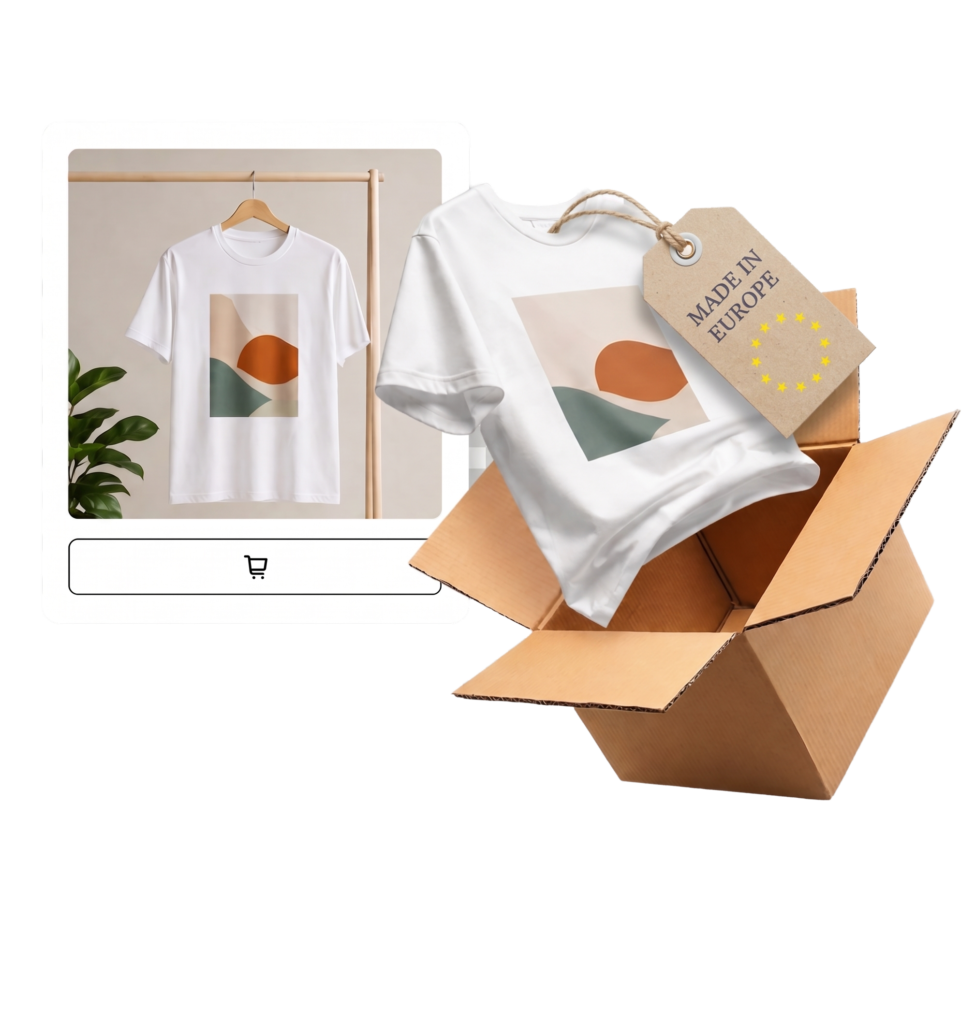
If your brand already sells to European customers, adding a European production partner starts with the products and orders you need that partner to handle. The important decisions concern product equivalence, artwork, order data, delivery expectations and the point at which a new production route is ready for live orders.
A successful launch gives each eligible order a clear path from the storefront to the correct product, print file and delivery service. This guide provides a practical planning framework for that work, using Print Logistic’s published production capabilities and integration information. The precise onboarding process and commercial terms are agreed for each project.
What European production means for an existing brand
An established brand has more to preserve than its artwork. Customers may already recognise a garment’s fit, fabric weight, print feel, packaging and delivery experience. A new production location must be evaluated against those expectations. A product that looks similar in a mockup can still differ in construction or sizing.
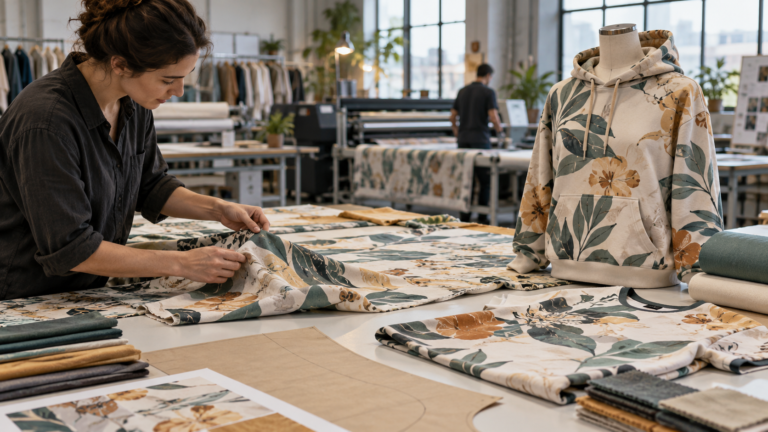
Print Logistic’s production facility in Łódź, Poland covers approximately 6,200 m². Its published capabilities include DTG, DTF, roll-to-roll all-over printing, cut-and-sew manufacturing, embroidery, sublimation, digital production printing and fulfillment. The facility supports individual POD orders, wholesale runs and enterprise workflows. These capabilities provide a starting point for a production discussion; availability must be confirmed for the exact product.
The Threadless and Print Logistic partnership illustrates the regional production model. The published case study describes EU production and fulfillment for eligible apparel orders placed through Threadless and Artist Shops. Eligibility depends on the product and delivery destination. It does not imply that every item in a platform’s catalog follows the same route.
For your own launch, establish that eligibility explicitly: which product, in which variant, with which artwork, can be produced at the agreed facility for which destinations?
1. Define the launch scope before moving the catalog
Start with your existing order data. Identify the products regularly bought by customers in the countries you want to serve. Review quantities, size distribution, artwork combinations, seasonal peaks and the frequency of mixed-product baskets. This reveals the actual workload a European production setup needs to support.
Choose an initial group that is commercially relevant and manageable to validate. A brand with hundreds of designs may first test a defined garment family, selected variants and agreed destinations. The scope should be driven by product suitability and operational readiness, rather than a target number of listings.
- Products: exact items, sizes, colours and decoration options included in the launch.
- Destinations: the countries covered by the initial agreement and their available delivery services.
- Channels: the storefronts, marketplaces or platform orders entering the new route.
- Exclusions: products or destinations that remain with the existing setup.
- Owners: the people who approve product changes, integrations and launch decisions.
Write down what happens when an order falls outside this scope. It may need to remain with the existing supplier, be held for review or follow another agreed process. That exception should have an owner before any automated routing goes live.
2. Match the physical product, not just the product name
Use your current specification alongside the proposed European item. Compare fibre composition, fabric weight, construction, measurements, size range, colour options, print area, decoration method and care information. Decide whether the item is an acceptable continuation of an existing listing or a new product that needs different customer-facing information.
The Print Logistic product catalog gives useful examples of why this matters. The listed men’s cotton AOP T-shirt is 100% cotton at 240 GSM, while the unisex cotton AOP hoodie is 90% cotton and 10% polyester at 280 GSM. A shared “cotton AOP” label does not mean identical fabric composition.
| Field | What to compare | Decision to record |
|---|---|---|
| Garment or item | Current product reference and proposed production SKU | Approved match, alternative product or not included |
| Material and construction | Composition, GSM, cut, seams and finishing | Accepted differences and any listing changes |
| Sizes and measurements | Actual measurement charts and available variants | Approved sizes and customer-facing size guidance |
| Decoration | Method, placement, coverage and required artwork | Approved template and sample reference |
| Presentation | Labels, packaging and accompanying information | Agreed presentation for the selected route |
If a substitute changes the product experience, update the listing, size chart or imagery before selling it. Review the cotton AOP manufacturing guide when your collection includes printed fabric and cut-and-sew construction.
3. Approve the sample and control the artwork version
Give every approved sample a traceable reference. Connect that reference to the production SKU, size, material, decoration method and artwork version. The team should be able to identify exactly which physical item was approved and which file produced it.
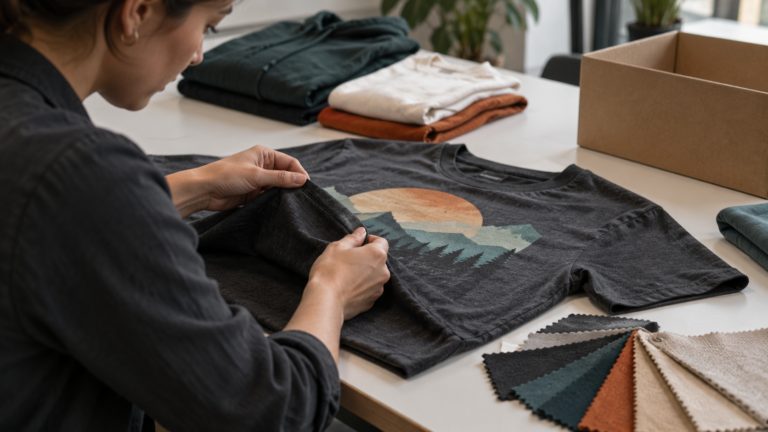
Review the sample against a written acceptance record. Capture measurements, print placement, colour reference, construction, finish and packaging observations. If wash performance or another product claim matters to the brand, agree the relevant testing and evidence separately. A visual inspection does not establish every aspect of product performance.
Our POD sample approval checklist provides a more detailed review structure. Use it to record approval, required changes or the need for another sample.
Then protect the approved artwork. Use an agreed naming and revision convention, with a clear owner for changes. If the design, blank, material, decoration method or production route changes, decide whether a fresh sample is required. This prevents an updated storefront image or replacement file from silently changing a product already released for sale.
4. Build and test the order-data route
An attractive sample does not prove that a live order will reach production correctly. The integration must connect the item a customer buys with the approved product variant and artwork. It also needs a defined response when information is incomplete or a product falls outside the agreed scope.
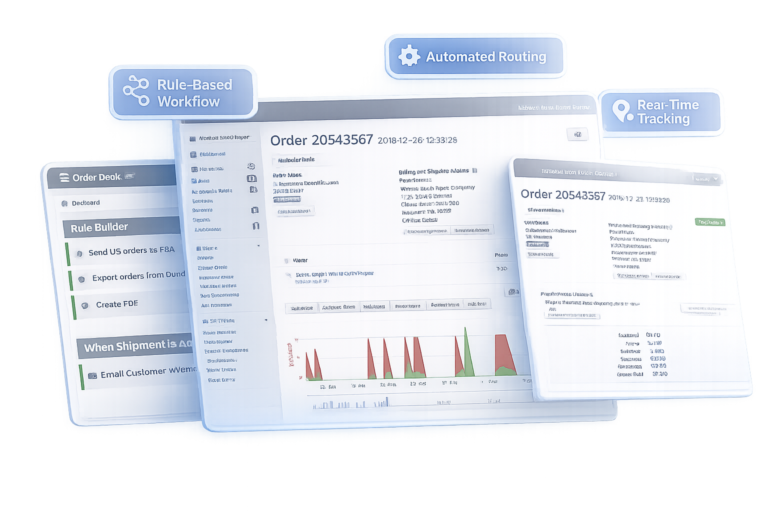
For brands using Order Desk, there is a documented Order Desk and Print Logistic integration. Order Desk’s own integration page describes assigning artwork and Print Logistic SKUs, detecting submission errors, matching shipping methods and selectively sending items for fulfillment. These functions still need configuration and testing for the brand’s order flow.
Prepare a mapping record that is readable by both commercial and technical teams. The following fields describe a recommended planning document, not a list of official API parameter names:
- The storefront product and variant identifier.
- The corresponding production SKU, size and colour.
- The approved artwork reference and decoration placement.
- The eligible destinations and selected shipping service.
- The rule for excluded items or incomplete information.
- The owner and resolution process for a failed submission.
Keep product approval separate from routing approval. A sample can pass while an integration rule still points to an old SKU. Conversely, correctly transmitted data cannot compensate for an unapproved garment substitution. Both decisions need evidence.
Before launch, test a mixed basket as well as a single-item order. Establish whether items are processed together or separately and how the customer receives shipment information. Confirm tracking behaviour for your specific setup rather than assuming every connected channel handles partial shipments identically.
5. Agree the full cost and the customer delivery promise
Compare equivalent production proposals. A useful quote identifies the product, decoration, relevant setup work, packaging, shipping service and any agreed extras. It should also explain which assumptions change the price. Keep sampling and integration work visible rather than hiding them inside a unit-cost comparison.
Use your actual order mix to assess the proposal. One-item orders, multi-item baskets, different destinations and replacement shipments can have different economics. Ask for comparable scenarios based on the items you intend to sell. Do not transfer savings reported by another business into your own forecast without checking the underlying products and routes.
For delivery, separate order receipt, validation, production readiness, production, dispatch and carrier transit. Agree what starts each clock and what happens when artwork or address information needs correction. Confirm working days, order cut-offs and any destination-specific exceptions before changing checkout estimates.
Also assign ownership of customer support, quality claims, returns, replacements and missing parcels. Ask how an issue is reported, what information is needed and who can approve the next action. Production location alone does not settle these responsibilities. They belong in the operating agreement for the products and destinations involved.
6. Run a controlled pilot with explicit release criteria
A pilot should answer whether the complete route works, including the cases most likely to cause a failure. Select test scenarios from your actual catalog and order patterns. Agree who reviews the results and what must be corrected before the scope expands.
| Scenario | What to verify | Evidence to retain |
|---|---|---|
| Eligible single-item order | Correct product, variant, file and destination route | Store order, production reference and received sample |
| Mixed basket | Eligible and excluded items follow their agreed routes | Item-level routing and shipment records |
| Incomplete artwork data | The issue is identified and handled before release | Recorded error and documented resolution |
| Address problem | A defined review and correction process exists | Owner, correction record and final outcome |
| Dispatch and receipt | Shipping service, tracking, package and item match the agreement | Dispatch record, tracking and inspection notes |
| Order change or issue | The team knows which actions are possible at each stage | Confirmed process and escalation contact |
Agree acceptance criteria before reviewing the pilot. These can cover correct item selection, artwork version, sample quality, routing accuracy and communication. Timing criteria should reflect the agreed product and service. A pilot with only straightforward orders leaves the handling of exceptions untested.
Keep a short issue log: the order reference, the problem, its cause, the corrective action and the retest result. Expand after the relevant issues are resolved. This produces a reusable operating record when the brand adds another product family or destination.
7. Move into live production without losing control of existing orders
Define a cutover rule with the current production setup. Specify which new orders enter the European route and what happens to orders already accepted elsewhere. Give each order one intended production destination and a visible status. Duplicate submissions can create duplicate production, while unclear ownership can leave an order unprocessed.
During the initial live period, review order exceptions and dispatch outcomes closely. Compare the ordered SKU with the produced item, record any manual corrections and inspect customer feedback against the sample approval. Use actual timestamps and agreed definitions when assessing production and delivery performance.
Add products deliberately. Each new material, decoration method or construction can introduce different file, sampling and handling requirements. The mapping record, approved sample and operating agreement should remain aligned as the catalog grows. If a fallback production route is proposed, validate its product specification before using it for customer orders.
What to send Print Logistic for a useful production discussion
A focused brief helps establish whether the proposed products, markets and order flow fit the available setup. Share the operational information needed to assess the project, including any gaps that still need to be resolved.
- Current range: product links or technical sheets, materials, sizes, colours and decoration requirements.
- Initial European scope: proposed products and delivery countries, with known exclusions.
- Order profile: typical quantities, mixed baskets, seasonal patterns and expected changes.
- Sales and order systems: storefronts, marketplaces and any existing order-management tools.
- Artwork: representative files, placement requirements and version-control arrangements.
- Product experience: current sample, size chart, packaging requirements and relevant quality evidence.
- Launch requirements: target date, proposed pilot scope and the people responsible for approval.
Ask the team to confirm product availability, proposed production route, sampling requirements, integration options, quotation assumptions and the next project-specific steps. Where a product cannot be matched, request a clearly identified alternative with its specification differences.
Frequently asked questions
Does a brand have to move its entire catalog to Europe?
A launch can be planned around selected products and destinations, subject to the agreed setup. The essential requirement is to define eligibility and exception handling clearly. Existing products should remain on their current route until the alternative has been approved.
Can the same artwork be used with a European production SKU?
Sometimes, but it needs to be checked against the exact product and decoration requirements. Differences in print area, garment dimensions or panel construction can require a revised file. Approve the actual item and artwork combination.
Does Print Logistic’s Order Desk integration remove the need for testing?
No. A documented integration provides available functions, while testing establishes whether your product mapping, artwork, destination rules and shipping choices behave correctly. Verify both straightforward orders and exceptions before release.
How long does onboarding take?
There is no single timeline established by the public information used for this guide. The schedule needs to account for product confirmation, sampling, any revisions, integration work and pilot approval. Obtain a project-specific plan before committing to a launch date.
Does production in Europe guarantee lower costs or faster delivery?
Neither outcome should be assumed for every order. Compare the selected product, production requirements, dispatch service, destination and full cost. Use the pilot and the agreed commercial terms to establish the customer promise for your own range.
Planning a European production route for your brand?
Send Print Logistic your product range, target countries and current order flow. We can discuss the available production options and the information needed to assess your project.
Discuss European production