Production planning guide · Print Logistic
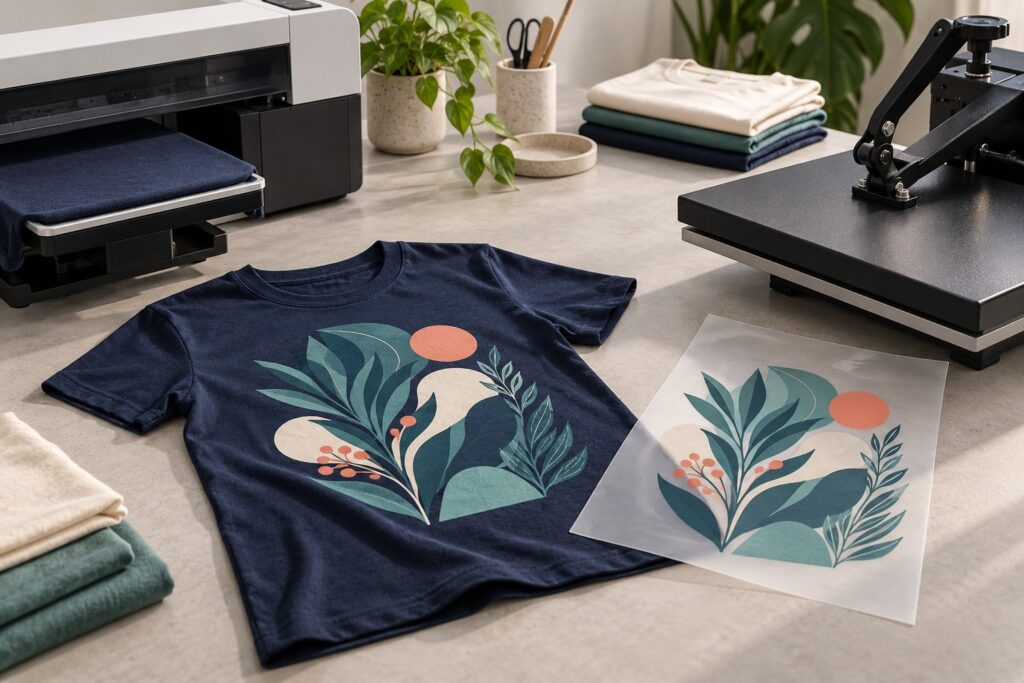
DTG prints ink directly onto a finished garment. DTF prints a design onto film before transferring it with heat. The useful question is which complete garment-and-print combination fits your product, artwork and customer expectations.
DTG and DTF at a glance
In this guide, DTF means direct-to-film. It does not mean roll-to-roll direct-to-fabric printing. If your design needs to cover fabric before cutting and sewing, start with our cotton all-over-print manufacturing guide.
| Decision | DTG: direct to garment | DTF: direct to film |
|---|---|---|
| How the artwork reaches the garment | Ink is printed directly onto the garment, followed by the required fixation or curing. | The image is printed onto film, prepared with adhesive and transferred using heat and pressure. |
| Fabric starting point | Cotton and suitable cotton-rich garments are common choices. Other fibres require a compatible process. | A broader range of compatible cotton, blended and synthetic garments can be considered. |
| Print feel | Often a softer result, particularly with restrained ink coverage on a suitable blank. | A transferred layer is present. Its feel depends on the transfer and the area of the design. |
| Dark garments | White ink and pretreatment or an integrated treatment workflow can affect the result. | Opacity, adhesive, garment dyes and heat response need checking. |
| Artwork | Photographs, gradients and detailed illustrations can work well. | Colourful graphics and logos can work well; small detached elements need particular attention. |
| Quantity | Suitable for individual orders and coordinated runs. | Suitable for individual orders and coordinated runs. |
Machine-specific instructions matter. For example, Epson explains the different equipment and fabric preparation used for DTG and DTFilm. Do not transfer one manufacturer’s settings to another production system.
Start with the fabric and the feel you want
Choose the exact blank before approving the decoration method. A print on a smooth cotton jersey and the same print on a textured hoodie are different products, even if both are described as DTG. Record the model, colour, composition, fabric weight and intended placement.
For a cotton T-shirt where a soft surface is central to the product, compare a DTG sample first. For a logo across several compatible garment types, DTF may be a useful candidate. Neither starting point replaces a finished sample.
A large solid rectangle covers more fabric than a design with open space. That affects how a decorated area bends and feels against the body. Compare the actual print size, not just a thumbnail. Ask the production team about heat-sensitive finishes, stretch, coated surfaces and possible dye migration on the chosen garment.
Print Logistic lists DTG and DTF among the technologies at its Poland production facility. Availability should still be checked for the specific product and destination workflow.
Use the same artwork to make a fair comparison
Order both samples with the same source artwork, garment colour and visible print dimensions wherever possible. A small chest logo cannot tell you how a full front graphic will feel.
- Fine lettering: inspect the smallest characters and isolated details at actual size.
- Gradients and transparency: ask how the production workflow handles faded edges and semi-transparent pixels.
- Dark backgrounds: check how the white layer changes the appearance of pale colours.
- Brand colours: approve a physical result under consistent lighting. A screen preview alone is insufficient.
- Placement: check collars, seams, pockets and print-area restrictions against the exact template.
There is no useful universal minimum line thickness for every DTF transfer. Supplier requirements differ. STAHLS’ artwork guidance is an example of why the selected production specification takes priority. Prepare your master artwork using our print-file preparation guide, then confirm the current requirements with production.
Compare the finished product cost, not the technology name
DTF is not automatically cheaper and DTG is not automatically faster. A meaningful quote needs the blank, artwork dimensions, number of placements, sizes, finishing, quantity and fulfillment model. Adding a sleeve graphic or a second print location changes the job.
Ask for comparable specifications and separate any setup or sampling costs from the repeat production price. If you are comparing one-at-a-time fulfillment with a planned collection, use our POD versus bulk production guide. Bulk is an ordering model; it does not necessarily mean screen printing.
Use the product catalog to shortlist products, then use the cost and margin worksheet to check the complete order economics.
A practical DTG versus DTF sample checklist
- Save the garment reference, colour, size, composition and artwork version.
- Approve the printed dimensions and placement, including the smallest size in the range.
- Compare edges, fine text, filled areas and colour appearance under the same lighting.
- Handle and gently stretch the decorated area as the garment would be used.
- Wash samples according to the agreed care instructions and record the conditions.
- Inspect the result again after drying: feel, adhesion, fading, distortion and garment shrinkage.
- Keep an approved physical reference and record what would trigger a new approval.
Do not promise a fixed number of washes based on the printing acronym alone. Durability depends on the fabric, application, curing and care. Our sample approval checklist helps turn the selected sample into a repeatable production reference.
Questions brands ask before choosing a method
Can DTG print on dark T-shirts?
Yes, with a suitable garment and production workflow. Judge the actual sample, including the white underbase and how the print feels.
Is DTF suitable for every polyester garment?
No single answer covers every dye, coating, finish or stretch fabric. Confirm compatibility and test the selected garment. A successful transfer on one polyester product does not approve every other product.
Can a brand use both DTG and DTF?
Yes. A collection can use different methods for different products or placements. Keep separate specifications and approved samples, and check the resulting appearance together.
Which method is best for all-over designs?
DTG and DTF decorate supported areas of finished garments. For a design that follows fabric panels and seams, investigate a suitable all-over-print and cut-and-sew workflow instead.
Plan your production with Print Logistic
Send the exact garment, artwork, print dimensions and target market. We can help you plan a sample and identify an appropriate production route.
Discuss your production planReferences and further reading
- Epson: DTG and DTFilm equipment and preparation
- STAHLS’: artwork and transfer guidance
- Kornit: DTG and DTF process comparison
Prepared 26 October 2026. Product availability and production specifications should be confirmed for the selected workflow.