
Production planning guide · Print Logistic
White-label print on demand combines a supplier-made product with your design and selling identity. The label, parcel and customer-facing documents are separate decisions. Agree each part of that experience before launching a collection.
What does white label mean in print on demand?
A white-label product starts from an existing product specification that can be sold under a merchant’s identity, with the agreed decoration and branding. You are not automatically commissioning an exclusive garment pattern or owning the underlying blank design.
The phrase can describe very different scopes. One workflow may provide a decorated garment and neutral packing documents. Another may include an approved neck print, a supplied insert or coordinated finishing. Ask for an itemised specification rather than treating “white label” as a complete service description.
| Term | What it usually refers to | What still needs agreement |
|---|---|---|
| White label | An existing product sold with the merchant’s identity and agreed decoration. | Visible labels, documents, packing and customer support arrangements. |
| Private label | A product programme developed for a particular brand, often with more control over specifications. | Ownership, exclusivity, minimums, development and the actual level of customisation. |
| Custom cut and sew | A production route using fabric panels and garment construction. | Pattern, fabric, sizing, sampling and manufacturing requirements. |
Supplier terminology varies. Put the requirements into writing. If the differentiator is a full-surface fabric design or construction, explore all-over print and cut-and-sew production rather than assuming a label change creates a custom garment.
Four layers of branding to specify separately
1. The product and decoration
Record the blank model, composition, colour, sizes and approved artwork placements. Decide whether a chest print, embroidered mark or all-over design is the product’s main brand expression. Compare the product catalog and, where appropriate, Stanley/Stella apparel before choosing the finishing.
2. Garment labels and trims
Discuss what is physically present on the garment: a brand label, size marker, fibre information and any other required information. An unbranded neck, a removable brand label and a custom printed label are different specifications. Do not assume every style from one brand has the same construction.
3. Fulfillment identity
Confirm the sender information, packing documents, return destination and any customer-facing material. Decide who answers an order query and what information customer care receives when a parcel is delayed.
4. Packaging and inserts
If your launch needs an insert, branded mailer or special presentation, agree storage, replenishment, picking, assembly, damage handling and destination restrictions. Availability of any option must be confirmed for the product, facility and order model.
Branding must preserve accurate product information
Do not treat all existing labels as removable. Check which information must stay with the product in each selling market. A marketing label does not automatically replace fibre, care, origin or responsible-business information required for that product.
For example, the UK government’s textile-labelling guidance explains fibre-content requirements and the responsibilities of manufacturers and retailers. Other destinations have their own rules; check the requirements for the market rather than copying one label across every route.
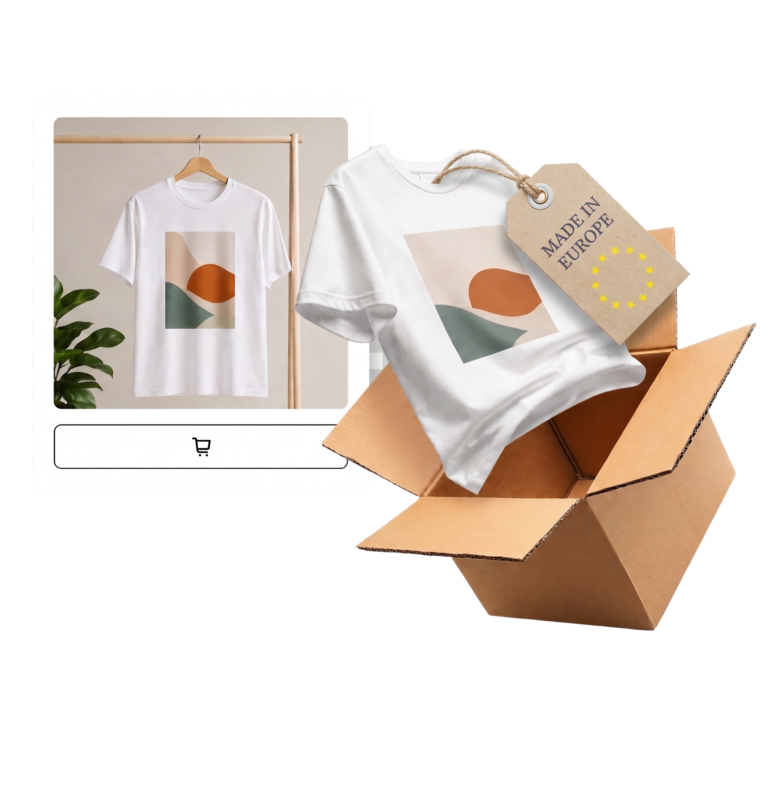
Decoration location and the origin of the underlying garment are separate facts. Do not infer a manufacturing-origin claim simply because a blank is printed in a particular country. Review any origin wording and certification claims against evidence for the exact product and supply chain.
A practical approval should show the garment interior as well as the front graphic. Photograph the neck area, side label and any added branding. If a label or material changes, record whether a new approval is required.
A white-label production brief you can send to a supplier
Use this as an enquiry checklist. It lists decisions to confirm, not options guaranteed on every Print Logistic product.
| Brief field | Information to provide or request |
|---|---|
| Product | Exact blank reference, colours, sizes, expected order mix and selling markets. |
| Artwork | Master files, intended dimensions, placement and an artwork version reference. |
| Garment identity | Existing visible labels; proposed branding method; information that must remain. |
| Packout | Required documents, insert quantity, folding, bagging and presentation reference. |
| Materials | Who supplies inserts or packaging, minimum purchase quantities, storage and replenishment. |
| Exceptions | What happens when a branding item is out of stock or an order needs another facility. |
| Commercial terms | Sampling, setup, per-item handling, storage, minimums and cancellation boundaries. |
| Approval | A physical reference, photographs, written sign-off and a change-control process. |
Keep separate cost lines for garment decoration, branding materials and fulfillment handling. Use the POD costs and margin guide to see how small additions affect an order’s contribution.
Approve a real parcel, not only a product mockup
- Order the exact garment with the intended decoration and branding.
- Inspect the size, placement, feel and readability of the proposed label.
- Check product information and claims against the actual garment.
- Review the packed parcel: item count, documents, insert and packing protection.
- Check how the parcel and customer notifications identify the sender.
- Repeat the check for a materially different market or production route.
- Retain the approved sample and record the specifications used to make it.
For personalised products, add a test with a long customer name or an unusually small size. Those edge cases can reveal placement and readability problems that a single medium-size sample does not show. Our sample approval checklist provides a broader product review.
Choose the operating model that matches the branding brief
A self-serve catalog workflow is useful when the product and agreed options already fit your launch. More involved finishing may require coordinated production, supplied materials or a wholesale programme. Treat operational complexity as a planning input, even when the storefront sells one item at a time.
Print Logistic provides Snapwear-connected print-on-demand workflows, wholesale production and production support for fashion brands. Its wholesale offering includes extended branding and finishing coordination; the exact method, minimums and availability need product-specific confirmation.
For a network serving more than one market, map branding materials to the actual production route. Decide whether a fallback can use neutral packaging, must wait for replenishment or needs manual approval. A silent substitution can change the customer’s experience after you have already approved the launch.
White-label questions to settle before launch
Does white label mean every supplier mark is removed?
Only if that exact scope has been agreed and it is appropriate for the product. Ask about the garment, labels, documents and parcel separately.
Can I add my own neck label to any blank?
Compatibility depends on construction, print area, existing labels and required information. Request confirmation for the exact style and approve the result.
Does a custom label make the product exclusive?
No. Exclusivity and ownership need separate agreement. A supplier may offer the same underlying blank to other brands.
Will the same packout work in Europe and the US?
Do not assume it. Confirm facility capabilities, material stock, shipping implications and destination requirements for each route.
Plan your production with Print Logistic
Send your product references, branding artwork, packout example and target markets. We can review the proposed workflow and identify which options need a sample or separate production agreement.
Discuss your production planReferences and further reading
- UK government: textile labelling
- Print Logistic: wholesale production and finishing scope
- Print Logistic: Snapwear-connected workflows
Prepared 26 October 2026. Product availability and production specifications should be confirmed for the selected workflow.