Quick answer: what German POD sellers must check before scaling
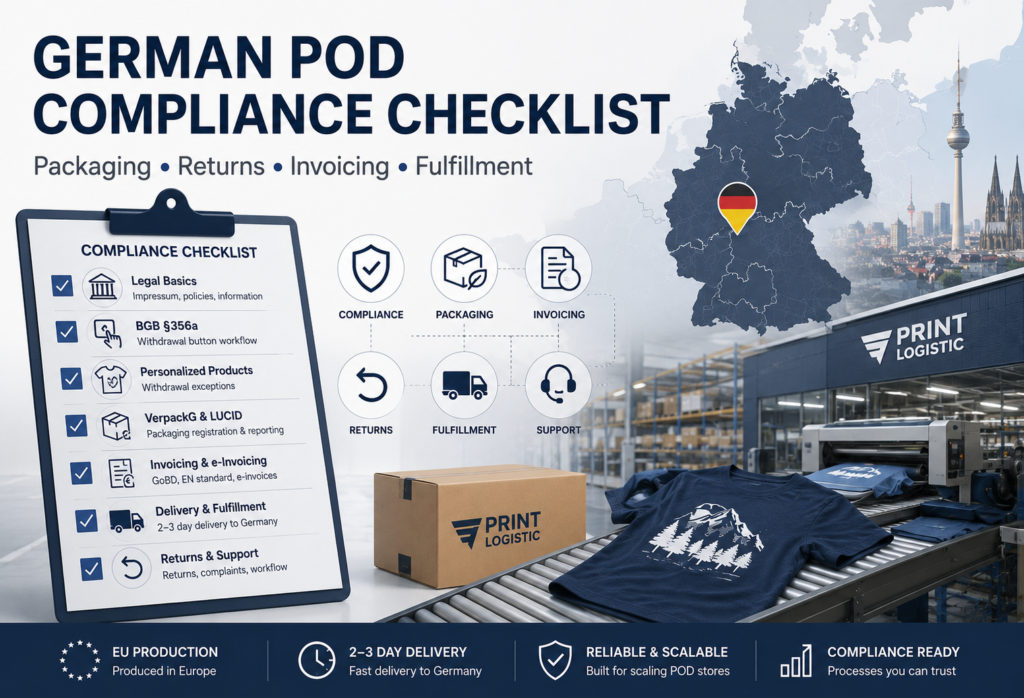
German POD compliance is not only about legal pages on a storefront. For scaling print-on-demand sellers, it connects packaging obligations, LUCID registration, withdrawal and return workflows, invoicing readiness, delivery promises, marketplace requirements and fulfillment visibility. A seller targeting German consumers should make sure that the website, product data, customer communication and fulfillment partner all support the same operational reality.
- Core areas: store information, withdrawal rights, BGB §356a, packaging, invoices, delivery promises, returns and marketplace workflows.
- Main risk: the store promises one thing, but the fulfillment process cannot support it.
- Best for: POD sellers, Shopify stores, WooCommerce stores, marketplace operators and e-commerce brands scaling in Germany.
- Fulfillment angle: compliance becomes easier when order status, production status, packaging data and delivery workflows are visible and structured.
Germany is one of the strongest e-commerce markets in Europe, but it is also one of the most demanding for print-on-demand sellers. A POD store selling to German customers cannot treat compliance as an afterthought. The business needs clear legal information, realistic delivery promises, structured return handling, packaging responsibility, invoice readiness and reliable fulfillment workflows.
For small POD experiments, these topics may feel secondary. For scaling stores, they become operational. If a seller receives hundreds or thousands of orders per month, unclear return rules, weak packaging documentation, poor order visibility or inconsistent customer communication can quickly become expensive.
This checklist is designed for growing POD sellers that want to sell into Germany professionally. It does not replace legal advice, but it shows the practical areas that should be reviewed before scaling German sales.
For the main operational guide, read our pillar page: POD fulfillment in Germany.
Scaling POD sales in Germany?
Print Logistic supports German POD fulfillment with EU-based production, 2–3 day delivery to Germany and workflows designed for sellers who need more than a basic POD app.
Talk to the Print Logistic team
Why Compliance Matters More in German POD Fulfillment
Print-on-demand creates a specific compliance challenge because the seller, the storefront and the fulfillment partner are often separate. The customer buys from the seller, but production, packing and delivery may happen through an external partner. If the process works well, the customer sees a professional brand experience. If the process is unclear, the seller is the one who receives the complaint.
In Germany, this matters because customers and platforms expect clarity. Delivery information should be realistic. Return information should be consistent. Product pages should not mislead. Packaging obligations should be understood. Invoice and order data should be structured. Customer support should be able to answer basic questions about production and delivery status.
For German POD sellers, compliance is therefore not only a legal department issue. It is part of fulfillment design.
Checklist Item 1 — Store Legal Basics and Customer Information
Before looking at fulfillment, a German-facing POD store should review the basic information shown to customers. This includes the legal identity of the seller, customer service details, return and withdrawal information, delivery conditions and pricing transparency.
Areas to check:
- Is the seller identity clearly shown?
- Is customer service contact information easy to find?
- Are delivery times realistic for German customers?
- Are shipping costs and taxes displayed clearly?
- Are withdrawal and return rules written in a way that matches the actual products sold?
- Are personalized products explained separately from standard catalogue products?
- Does the checkout experience match the information shown on product pages?
This is especially important when a POD store sells both standard designs and personalized items. A generic “no returns on POD products” message can be too broad if some products are not actually personalized. Sellers should work with legal counsel to define accurate rules for each product category.
Checklist Item 2 — BGB §356a and the Withdrawal Button Workflow
Since 19 June 2026, German law requires an electronic withdrawal function for certain online B2C distance contracts. This is commonly called the Widerrufsbutton or withdrawal button. For POD sellers, the key issue is not only whether the button exists. The more important question is whether the business can process the withdrawal signal correctly.
Recommended external sources:
- Noerr: Implementing legislation for the withdrawal button
- Freshfields: Pitfalls for e-commerce and the new withdrawal button
- EUR-Lex: Directive (EU) 2023/2673
POD sellers should check:
- Can the withdrawal request be linked to the correct order ID?
- Does the system show whether the order has entered production?
- Can customer support identify whether the product is personalized?
- Is the customer sent confirmation of the withdrawal request?
- Does the workflow distinguish between cancellation, withdrawal, return and complaint?
- Does the fulfillment partner provide production status quickly enough to make a decision?
For a dedicated explanation, read our article on BGB §356a withdrawal button for POD stores.
Checklist Item 3 — Personalized POD Products and Withdrawal Exceptions
Personalization is one of the most important legal and operational topics in print on demand. EU consumer law includes an exception for goods made to the consumer’s specifications or clearly personalized. This can be relevant for products such as custom text apparel, photo products, personalized gifts or items created from customer-uploaded artwork.
However, POD sellers should be careful. Not every print-on-demand product is automatically “clearly personalized.” A standard design printed on demand after purchase may be operationally made to order, but that does not always mean it falls under the personalized-goods exception. This distinction should be reviewed with legal counsel.
Recommended external source:
Operationally, sellers should separate products into clear categories:
| Product type | Example | Operational requirement |
|---|---|---|
| Standard POD product | A shirt with a pre-designed graphic from the store catalogue | Review normal withdrawal and return handling. |
| Personalized POD product | A hoodie printed with the customer’s name or uploaded image | Flag as personalized in product data and customer communication. |
| Mixed cart | One standard item and one personalized item in the same order | Apply different handling logic where necessary. |
| Marketplace item | A POD product sold through a marketplace listing | Check both legal rules and marketplace policy. |
For scaling sellers, this classification should not exist only in legal text. It should also be reflected in product tags, order data, support procedures and fulfillment workflows.
Checklist Item 4 — VerpackG, LUCID and Packaging Obligations
Packaging compliance is one of the most important areas for e-commerce sellers in Germany. The Central Agency Packaging Register, ZSVR, explains that companies distributing packaged goods commercially in Germany must be registered with the LUCID Packaging Register. For packaging subject to system participation, additional obligations include system participation and regular packaging volume reporting.
Recommended external sources:
- ZSVR: Quick check — do these obligations apply to me?
- ZSVR: Packaging law obligations for fulfilment
- ZSVR: System participation and data reporting
This matters for POD because the seller may not physically touch the packaging. The product may be printed, packed and shipped by a fulfillment partner. But the seller still needs to understand who is legally responsible for the packaging placed on the German market.
According to ZSVR guidance for companies commissioning fulfilment providers, ordering parties may need to register with LUCID, conclude a system participation agreement and report packaging volumes for packaging subject to system participation. This makes packaging compliance an operational topic, not only a legal footnote.
POD sellers should check:
- Are you registered with the LUCID Packaging Register where required?
- Do you understand which packaging types are used for German shipments?
- Do you know whether packaging is subject to system participation?
- Are packaging volumes reported correctly where required?
- Does your fulfillment setup provide the information needed for compliance checks?
- Are marketplace verification requirements covered?
Checklist Item 5 — Fulfillment Service Providers and Responsibility
Many POD sellers assume that if a fulfillment partner ships the order, the partner automatically handles all compliance responsibility. That assumption can be dangerous. In Germany, the legal and operational responsibility may depend on the specific role of each party, the packaging type, the sales model and the contractual setup.
The practical lesson is simple: sellers should not outsource responsibility without understanding the process.
Before scaling German orders, ask your fulfillment partner:
- Who places the packaging on the German market?
- What packaging types are used?
- Can packaging data be provided for reporting?
- Can marketplace compliance checks be supported?
- How are returns and undeliverable parcels handled?
- Can order status, production status and shipment status be accessed reliably?
This is why choosing a POD partner for Germany should not be based only on base product cost. The fulfillment partner becomes part of the seller’s compliance environment.
Checklist Item 6 — Invoicing, Order Data and E-Invoicing Readiness
Germany is also moving through a major B2B e-invoicing transition. The European Commission explains that B2B e-invoicing becomes mandatory progressively from 2025 and that companies must be able to receive EN-compliant e-invoices as of 1 January 2025.
Recommended external sources:
- European Commission: eInvoicing in Germany
- European Commission: 2025 Germany eInvoicing Country Sheet
For POD sellers, the important point is not only the invoice format. The deeper issue is order data quality. A growing store should be able to connect:
- order ID,
- customer details,
- product SKU,
- personalization status,
- production status,
- shipping status,
- invoice data,
- refund or return history.
If these data points are fragmented across several tools, compliance and customer support become harder. If they are structured, the seller can manage German growth with more confidence.
Checklist Item 7 — Delivery Promises and Order Status Visibility
Delivery information is a trust signal in Germany. If a POD store promises fast delivery but cannot show accurate order status, customer experience suffers. This is especially risky when sellers run paid campaigns, marketplace listings or seasonal promotions.
Before scaling German sales, sellers should check:
- Are delivery times to Germany realistic?
- Can production and shipping timelines be separated clearly?
- Does the store show realistic expectations for personalized products?
- Can customer support access order status quickly?
- Are tracking updates reliable?
- Does the fulfillment partner support peak-season order volume?
Print Logistic supports German POD sellers with EU-based production and 2–3 day delivery to Germany. For a full operational overview, see our guide to POD fulfillment in Germany.
Checklist Item 8 — Returns, Complaints and Customer Support Workflow
Returns in POD are not always simple. A customer may want to withdraw from the contract, return a product, complain about quality, change an order or cancel before production. These situations should not be treated as one generic “return request.”
A German POD store should separate:
- Withdrawal — a consumer-rights process where applicable.
- Cancellation — a request to stop an order before production or dispatch.
- Return — a physical product coming back after delivery.
- Complaint — a quality, damage, misprint or delivery issue.
- Refund review — the financial decision after the operational status is known.
This distinction is essential because the right answer depends on the product type and order status. A personalized item already in production may require different handling than a standard product that has not yet been produced.
For scaling stores, customer support needs practical rules, not vague principles. Support teams should know what to ask, where to check order status and when to escalate the case.
Checklist Item 9 — Marketplace Readiness: Amazon, eBay, Otto.de and German Buyer Expectations
German POD sellers often expand beyond their own Shopify or WooCommerce store. Marketplaces can bring demand, but they also add operational pressure. Delivery performance, product data, return handling, seller information and customer service standards may all influence marketplace success.
Before listing POD products on German marketplaces, sellers should review:
- product title and description accuracy,
- delivery time settings,
- return policy alignment,
- seller information requirements,
- packaging and EPR verification requirements,
- tracking availability,
- complaint and refund handling,
- inventory or production status logic.
For POD, marketplace readiness is not only about getting listings approved. It is about making sure the fulfillment workflow can support marketplace expectations after sales begin.
Checklist Item 10 — PPWR and Future Packaging Expectations
The EU Packaging and Packaging Waste Regulation, known as PPWR, is another reason why packaging strategy should be reviewed now. According to official UK government guidance on EU regulatory updates, PPWR entered into force on 11 February 2025 and will apply from 12 August 2026. The regulation is available in EUR-Lex as Regulation (EU) 2025/40.
Recommended external sources:
- EUR-Lex: Regulation (EU) 2025/40 on packaging and packaging waste
- UK Government: EU Packaging and Packaging Waste Regulation overview
For POD sellers, PPWR is not only a future legal topic. It is also a brand-trust topic. German and wider European customers are increasingly sensitive to sustainability claims, packaging waste and recyclability. Sellers should avoid vague green claims and work with fulfillment partners that can provide clear packaging information.
German POD Compliance Checklist Table
| Area | What to check | Why it matters | Fulfillment impact |
|---|---|---|---|
| Store information | Seller identity, contact data, delivery and return information | German customers expect transparency and clear business information | Customer support must match what the storefront promises |
| BGB §356a | Withdrawal button, confirmation flow and order linkage | Withdrawal requests must be processed consistently | Order status and production status must be visible |
| Personalization | Standard vs personalized POD products | Withdrawal handling may differ by product type | Product tags and order data should identify personalization clearly |
| Packaging | LUCID registration, system participation and packaging volumes | German packaging law creates obligations for companies distributing packaged goods | Fulfillment partners should provide packaging information where needed |
| Invoicing | Order data, invoice data and e-invoicing readiness | Germany is moving through progressive B2B e-invoicing requirements | Clean order data makes accounting and support easier |
| Delivery | Realistic delivery promises and tracking | Delivery reliability affects trust and conversion | Production and shipping timelines must be predictable |
| Marketplace readiness | Product data, returns, EPR checks and performance metrics | Marketplaces can enforce stricter operational expectations | Fulfillment must support listing promises after sales begin |
| Customer support | Complaint, cancellation, withdrawal and return procedures | German customers expect clear and timely responses | Support teams need production-status visibility |
How Print Logistic Supports German POD Operations
Print Logistic is designed for POD sellers that need more than a basic print-on-demand app. For Germany, the value is in combining EU-based production, fast delivery, order workflow visibility and operational thinking.
For scaling sellers, Print Logistic can support:
- EU-based POD production,
- 2–3 day delivery to Germany,
- more predictable fulfillment workflows,
- support for order status and production visibility,
- alignment between sales channels and fulfillment,
- operational readiness for compliance-sensitive markets,
- better preparation for marketplace and multi-channel sales.
This does not replace legal advice, accounting advice or packaging compliance review. But it helps sellers build the operational layer that German growth requires.
Need a stronger fulfillment setup for Germany?
If your POD store is growing in Germany, review your delivery promises, packaging responsibilities, return workflows and order data before scaling further.
Explore POD fulfillment in Germany
Final Takeaway
German POD compliance is not a single checklist item. It is a system. A seller needs a legally reviewed storefront, accurate product information, clear withdrawal and return handling, packaging awareness, structured order data and fulfillment workflows that match the promises made to customers.
The strongest German POD operations connect the front end and the back end. The customer sees clear delivery information and return rules. The seller sees order status, production status and fulfillment data. The support team knows how to handle cancellations, withdrawals and complaints. The fulfillment partner supports the process instead of creating uncertainty.
That is the difference between simply selling POD products in Germany and building a scalable German POD operation.
Continue with the main guide: POD Fulfillment Germany: 2–3 Day EU Production for Scaling Online Stores.
Frequently Asked Questions
What is German POD compliance?
German POD compliance means preparing a print-on-demand store and its fulfillment workflow for German legal, operational and marketplace expectations. It can include customer information, withdrawal rules, returns, packaging obligations, invoicing, delivery promises and product data.
Do POD sellers need LUCID registration in Germany?
Companies distributing packaged goods commercially in Germany may need to register with the LUCID Packaging Register. For packaging subject to system participation, additional obligations may apply, including system participation and packaging volume reporting. Sellers should review ZSVR guidance and obtain specialist advice for their setup.
Does a fulfillment provider handle all German packaging obligations?
Not automatically. If a seller commissions a fulfillment provider, the seller should still understand who is responsible for packaging registration, system participation, reporting and marketplace verification. Responsibility depends on the role of each party and the packaging setup.
Does BGB §356a affect POD sellers?
It can. Since 19 June 2026, certain German-facing B2C online contracts require an electronic withdrawal function. For POD sellers, this creates operational questions around withdrawal requests, production status, personalized products and customer communication.
Are personalized POD products exempt from withdrawal rights?
EU consumer law includes an exception for goods made to the consumer’s specifications or clearly personalized. However, not every POD product is automatically covered by that exception. Sellers should classify product types carefully and consult legal counsel.
Why is order status visibility important for German POD compliance?
Order status visibility helps sellers respond to withdrawal, cancellation, return and complaint requests accurately. If customer support cannot see whether an order is pending, in production, shipped or delivered, German customer communication becomes harder and riskier.
What should a German POD fulfillment partner support?
A strong German POD fulfillment partner should support predictable delivery, production-status visibility, clear order workflows, reliable packaging information, product data structure and scalable fulfillment for growing stores.