Production planning guide · Print Logistic
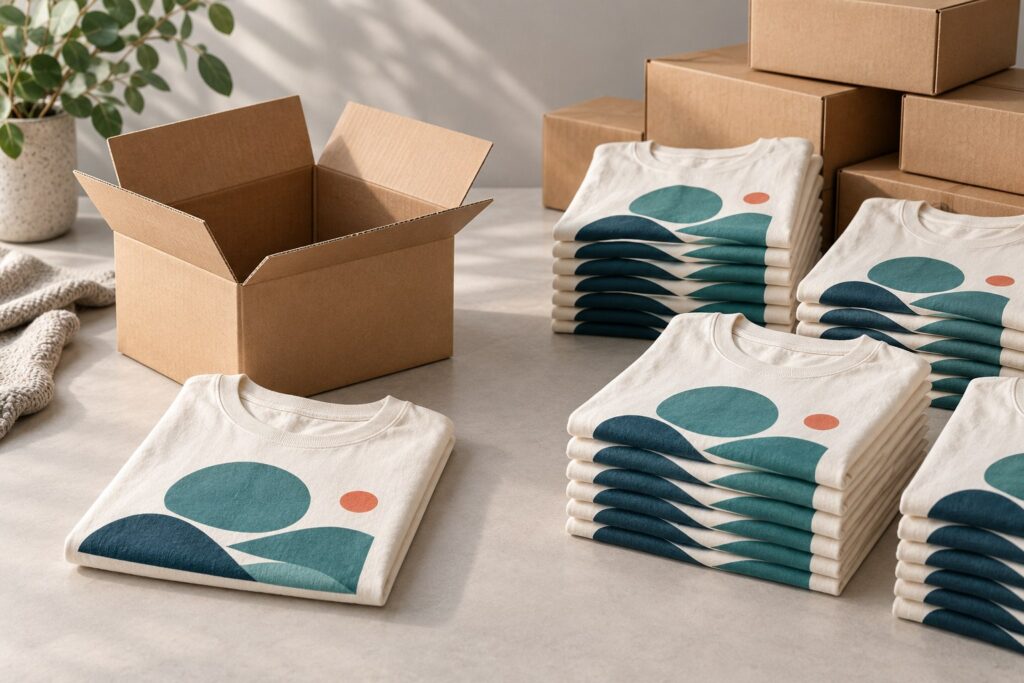
Print on demand delays finished-product production until orders arrive. Bulk production commits to a planned quantity. A lower bulk unit price helps only when the quantity, sales pattern and fulfillment costs support that commitment.
Production model and printing technology are separate choices
A bulk run can use DTG, DTF, sublimation or another suitable process. An individual POD order can use several of those methods too. Comparing “POD” with “screen printing” without specifying the garment and decoration mixes two different decisions.
First choose a suitable product and method, using the product catalog and our DTG versus DTF comparison where relevant. Then compare how the products are ordered, paid for, held and dispatched.
| Planning issue | Individual POD | Planned bulk production |
|---|---|---|
| Finished stock | Made for the orders released to production. | A quantity is produced before all units necessarily have buyers. |
| Cash commitment | Builds as orders are produced; samples and other costs still exist. | Includes the agreed batch and any associated setup or material purchases. |
| Variant risk | Finished sizes and designs follow actual orders. | The size, colour and design mix must be planned. |
| Dispatch | Includes production before each order ships. | Stock can be dispatched after receipt and the required fulfillment checks. |
| Typical use | Testing designs, long-tail variants and personalised products. | Confirmed campaigns, replenishment and demand with an evidence-based quantity. |
A worked comparison using expected sales
Assume an on-demand production cost of €12 for each unit sold. The alternative is a batch of 150 units at €8 each, plus €120 setup, €60 inbound transport and €45 of holding-related costs for the planning window.
POD production spend = units sold × €12
| Units sold in the period | POD production spend | Bulk commitment | Bulk commitment per unit sold | Units left from batch |
|---|---|---|---|---|
| 60 | €720 | €1,425 | €23.75 | 90 |
| 100 | €1,200 | €1,425 | €14.25 | 50 |
| 150 | €1,800 | €1,425 | €9.50 | 0 |
This is a cash-commitment comparison for a defined period, not an accounting valuation of stock. It assumes no cash is recovered from the remaining stock during that period; those units may sell later.
The bulk commitment becomes lower than the illustrated POD production spend at 119 units sold: €1,425 ÷ €12, rounded up. That requires about 79.3% sell-through of the purchased batch. The advertised €8 batch unit price alone does not reveal that threshold.
Add the costs that can change the result
The production-only example is a starting point. Add each cost to the model where it is incurred. If bulk handling costs more per dispatched order, its advantage may shrink; if the actual batch requires less setup, it may improve.
- Storage and receiving: when charges start, the space used and the cost of counting or putting stock away.
- Order fulfillment: picking, packing, inserts, individual delivery and any multi-item handling.
- Stock losses: observed damage, missing units, obsolescence and the cost of recovering slow stock.
- Replenishment: a repeat order may have different setup, minimums or lead times.
- Sales realisation: discounts or clearance can reduce the revenue earned from the last units.
- Working capital: the timing of production payments and customer payouts.
Use the POD cost and contribution guide to connect the production comparison with what remains from each customer order.
Evaluate demand by variant, not just by design
A bestseller with 300 sales does not automatically justify the same quantity of every size and colour. Build a variant view: style, colour, size, print version, recent sales, stock, return observations and reorder lead time.
A useful batch can concentrate on proven variants while keeping slower combinations on demand. For example, a recurring design might justify stock of its most consistent sizes without committing to every colour in the catalog.
Check that demand is repeatable. A one-day promotion, a creator mention and a recurring retail order are different signals. Look at paid orders, cancellations and delivered outcomes rather than a social post’s audience size alone. Do not treat an abandoned checkout as a production commitment.
When each model is a useful starting point
Consider individual POD when
- The design or audience is still being tested.
- Personalisation changes the product for each customer.
- The range includes many slow or uncertain variants.
- You value the option to change the artwork before producing more finished stock.
Consider a coordinated bulk quote when
- There is a confirmed campaign, event or order quantity.
- Repeat sales support a specific size and colour mix.
- The budget covers the batch, holding and fulfillment costs.
- Stock and delivery responsibilities are agreed before production starts.
Print Logistic supports both Snapwear-connected POD and wholesale production. Compare a written specification for the actual products and quantities. The wholesale page’s example pricing illustrates quantity effects, but a launch decision needs a current, comparable quote.
A practical hybrid launch and replenishment plan
- Approve the product. Use a physical sample and the sample approval checklist before collecting demand at scale.
- Launch a controlled range. Keep artwork versions, print dimensions and variants consistent enough to learn from the results.
- Measure demand. Review orders by SKU, destination and period, including cancellations and service outcomes.
- Quote proven variants. Request comparable batch quantities and separate setup, stock and dispatch costs.
- Define the stock boundary. State which variants ship from stock and which remain on demand.
- Set a reorder trigger. Base it on expected demand during the confirmed replenishment lead time plus an explicit buffer.
- Review again. Slow the next purchase if sell-through weakens or the product changes.
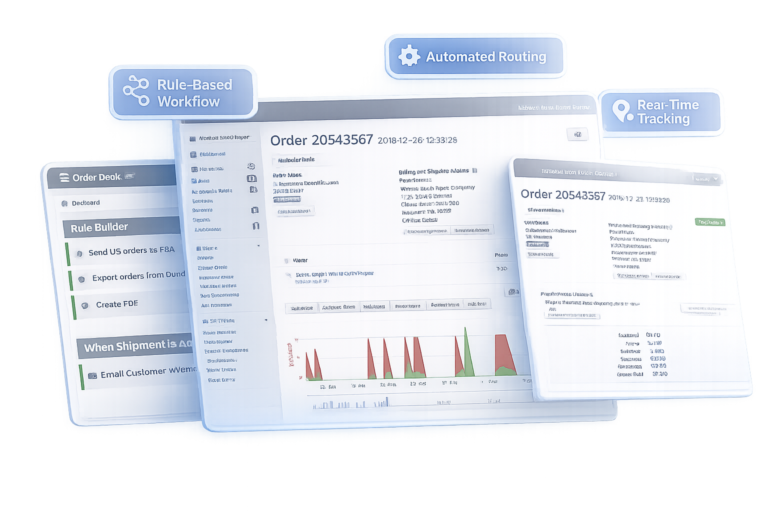
In a mixed workflow, stock units and made-to-order units need clear routing. Define what happens when stock runs out, whether a substitute production route is allowed and how the customer delivery promise changes. Our Order Desk routing guide covers the data and exception-handling side of production routing.
POD versus bulk: practical questions
Is bulk always cheaper?
A lower purchase price per unit does not guarantee lower cost per unit sold or lower cash committed. The answer depends on quantity, sell-through, setup, storage and fulfillment.
Should every bestseller move to bulk?
No. Check the individual variants, the persistence of demand and the money tied up in stock. Personalisation and a wide long tail can remain a good fit for POD.
Can I use bulk and POD in the same store?
Yes, if the products, stock records, routing and customer promises are configured accordingly. Approve the experience for mixed orders instead of assuming they behave like single-product shipments.
Plan your production with Print Logistic
Send your current product specification, variant sales pattern, proposed batch quantity and fulfillment requirements. We can review a production model around the demand you can support.
Discuss your production planReferences and further reading
- Print Logistic: wholesale production, quantity examples and scope
- Print Logistic: production infrastructure for fashion brands
- Print Logistic: sample approval checklist
Prepared 26 October 2026. Product availability and production specifications should be confirmed for the selected workflow.